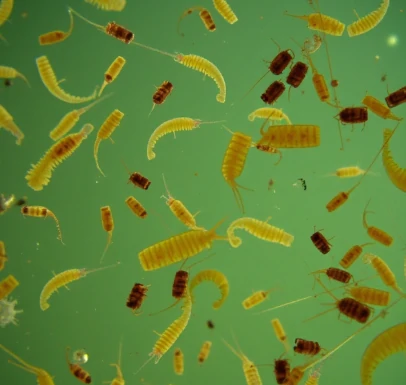
Animal plankton—drifting organisms that cannot swim against currents—are known as zooplankton. They range from tiny protozoa and the larval stages of fish and invertebrates to larger krill, jellyfish, and salps. Most feed on phytoplankton or on other zooplankton, forming critical links in marine food webs.
Many zooplankton undertake daily vertical migrations, rising toward the surface at night to feed and descending by day to avoid predators. This behavior constitutes one of the largest synchronized animal movements on Earth. Zooplankton biomass and community composition respond rapidly to changes in temperature, productivity, and predation, making them sensitive indicators of ecosystem state.
Sampling traditionally uses nets of various mesh sizes; optical and acoustic methods and environmental DNA are expanding observational capacity. Because zooplankton transfer energy from primary producers to fish and marine mammals, their dynamics influence the productivity of fisheries and the efficiency of the biological carbon pump.
- Animal component of the plankton
- Link phytoplankton to higher trophic levels
- Many migrate vertically each day
- Sensitive indicators of ocean change
Comments (3)
Leave a comment