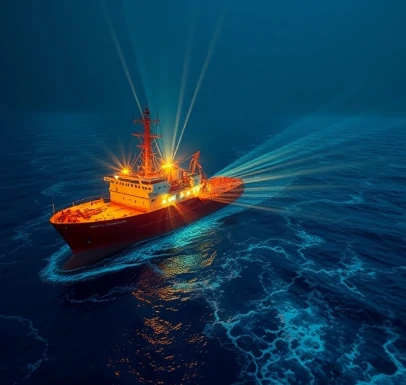
Sound travels farther in water than light or radio waves, making it the preferred tool for sensing the underwater environment. Sonar—sound navigation and ranging—emits acoustic pulses and interprets the returning echoes to detect objects, measure distances, and map surfaces.
Active sonar transmits a signal and listens for reflections; passive sonar only listens for sounds produced by the targets themselves. Applications include seafloor mapping, fish finding, navigation, submarine detection, and communication. Frequency choice involves a trade-off: high frequencies give finer resolution but shorter range; low frequencies travel farther but resolve less detail.
Scientific sonars measure biomass, detect gas bubbles, and image geological structures. Military and commercial systems have different design priorities. Concern about the effects of intense sonar on marine mammals has led to operational restrictions in some regions. Despite the growth of optical and electromagnetic methods, sonar remains indispensable for most underwater remote sensing.
- Uses sound to detect and locate underwater objects
- Active and passive forms
- Essential for mapping, fishing, and navigation
- Frequency determines range and resolution
Comments
No comments yet. Be the first to share a thought.
Leave a comment