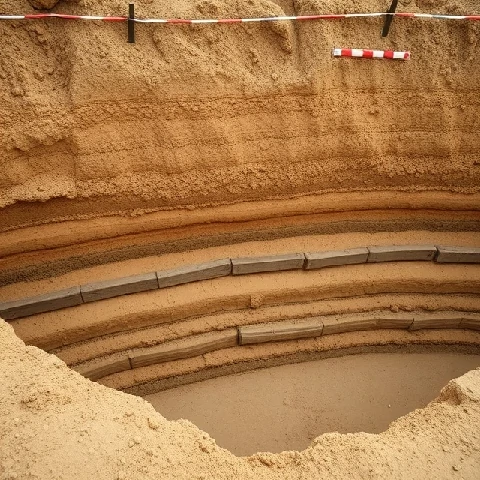
Layers of soil and rock accumulate in sequence. Stratigraphy is the study of those layers, their order, and their relationships, used to establish relative chronology in archaeology and geology.
The principle of superposition holds that, in undisturbed deposits, lower layers are older than higher ones. Archaeologists record the stratigraphic context of every find so that associations and sequences can be reconstructed. Geological stratigraphy correlates rock units across regions and ties them to the geologic time scale.
Disturbances—pits, burrows, erosion—complicate interpretation and must be recognized in the field. Drawing sections, photographing layers, and increasingly using digital recording preserve stratigraphic information. Without careful stratigraphy, the chronological value of excavated material collapses.
- Study of layered deposits and their order
- Basis of relative dating in archaeology
- Relies on superposition and context
- Requires careful field recording
Comments
No comments yet. Be the first to share a thought.
Leave a comment