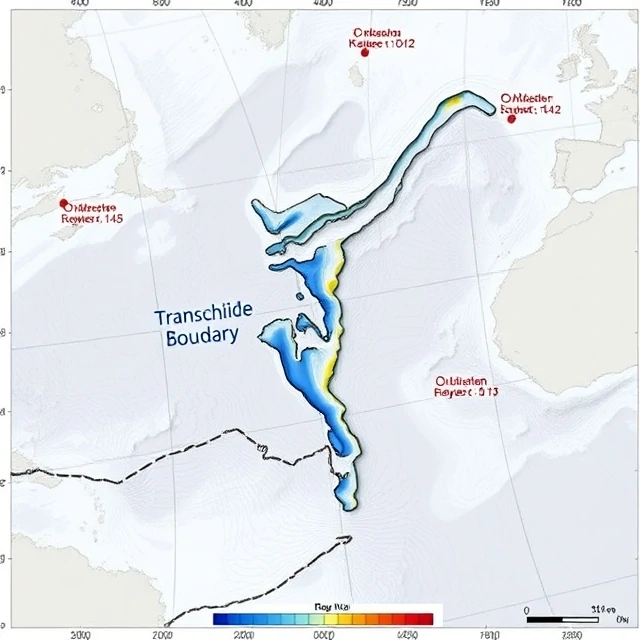
Plates can slide past each other without creating or destroying crust. A transform boundary is the zone where this horizontal shear occurs. The motion is typically localized on one or more strike-slip faults.
Most transform boundaries offset segments of mid-ocean ridges, allowing the spreading centers to accommodate motion on a spherical Earth. The San Andreas Fault in California is a continental transform boundary between the Pacific and North American plates. Earthquakes along transforms are frequent but usually shallower than those in subduction zones.
Because crust is neither created nor consumed, transform boundaries lack the volcanism characteristic of divergent and convergent margins. They do, however, produce linear valleys, offset streams, and other distinctive geomorphic features. Understanding transform motion is essential for assessing seismic hazard in regions such as California and New Zealand.
- Plate boundary with horizontal shear motion
- Neither creates nor destroys crust
- Often offsets mid-ocean ridges
- Characterized by strike-slip faulting and earthquakes
Comments
No comments yet. Be the first to share a thought.
Leave a comment