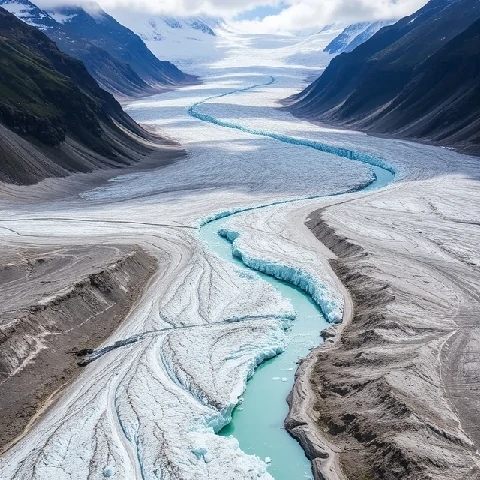
Snow that survives summer after summer eventually turns to ice and begins to flow. A glacier is a persistent mass of dense ice that moves under its own weight. Valley glaciers descend mountain slopes; ice sheets cover entire continents.
Glaciers erode bedrock, transport debris, and deposit characteristic landforms such as moraines and drumlins. They store most of the world’s freshwater and respond sensitively to climate. Advance and retreat of glaciers have shaped landscapes across much of the Northern Hemisphere.
Today most glaciers are shrinking as global temperatures rise. Meltwater contributes to sea-level rise and alters downstream water supplies. Scientists monitor glacier mass balance with field measurements and satellite imagery to track the rate of change.
- Large moving mass of dense ice
- Forms from compacted snow
- Erodes and deposits distinctive landforms
- Major store of freshwater currently in decline
Comments
No comments yet. Be the first to share a thought.
Leave a comment