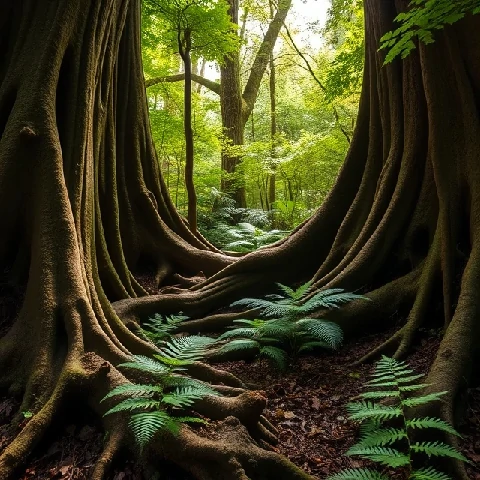
Rainforests cover about six percent of Earth's land surface but hold more than half of its terrestrial species. They are dense forests with high rainfall, usually more than 2,000 millimeters a year, and warm temperatures year-round. The largest is the Amazon, followed by the Congo Basin and the forests of Southeast Asia. Rainforests are layered: an emergent layer of tall trees, a continuous canopy, an understory of shade-tolerant plants, and a dark forest floor. Each layer supports different species.
Rainforests are among the most productive ecosystems on Earth. They cycle water, store carbon, and regulate regional climate. The Amazon releases so much moisture that it creates its own rainfall patterns, sometimes called flying rivers. Deforestation threatens all of this. Clearing for cattle, soy, palm oil, and timber has destroyed large areas. Scientists warn that parts of the Amazon may be approaching a tipping point, where the forest can no longer generate enough rain to sustain itself and transitions to savanna.
Why rainforests matter
- Harbor over half of terrestrial species.
- Store vast amounts of carbon.
- Regulate regional and global rainfall.
- Source of medicines, foods, and cultural knowledge.
Rainforests are not just collections of trees. They are complex systems that took millions of years to develop and can be destroyed in a few decades.
Comments (2)
Leave a comment