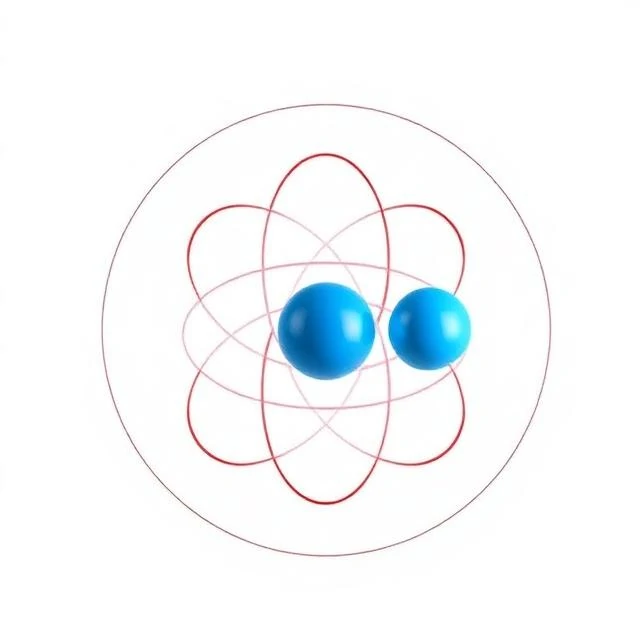
Ernest Rutherford discovered the proton in 1917. It is a positively charged subatomic particle found in the nucleus of every atom. Its charge is equal and opposite to that of the electron, 1.602 times 10 to the minus 19 coulombs. Its mass is about 1.672 times 10 to the minus 27 kilograms, roughly 1,836 times the mass of an electron. The number of protons in a nucleus determines the element. It is the atomic number.
The proton is a baryon, made of two up quarks and one down quark. The quarks are held together by the strong nuclear force, mediated by gluons. The proton is stable in isolation, unlike the neutron, which decays in about 15 minutes. In some theories beyond the Standard Model, the proton can decay, but no decay has ever been observed. The proton appears to be stable.
The proton's positive charge attracts electrons and allows atoms to form. It also causes repulsion between protons in the nucleus, which is overcome by the strong nuclear force. The balance between these forces determines nuclear stability. In stars, protons fuse to form helium, releasing energy. That is the power source of the Sun.
The proton is used in medicine for proton therapy, which targets tumors with precise doses of radiation. It is used in physics for proton-proton collisions at the Large Hadron Collider. It is a fundamental building block of matter.
Comments (3)
Leave a comment