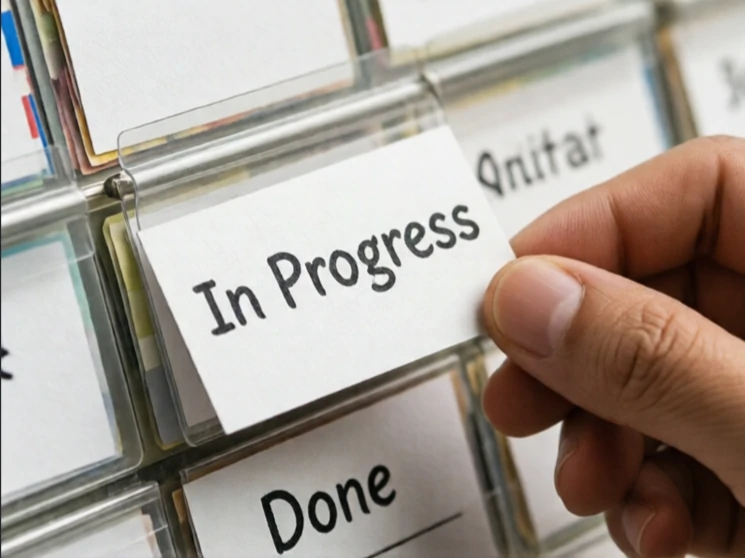
Work can be managed by visualizing its flow. Kanban is a method that does exactly that. Tasks are represented as cards that move across a board divided into columns such as “To Do,” “In Progress,” and “Done.” Limits on the number of cards allowed in each column prevent overload and highlight bottlenecks.
Originating in manufacturing, Kanban has been widely adopted in software development and knowledge work. The board makes the state of the work visible to the whole team. Pull-based flow replaces push-based assignment: team members pull new work only when capacity is available. Continuous improvement is encouraged by examining the flow and adjusting policies.
Kanban is less prescriptive than some other agile frameworks; it can be layered onto existing processes. Its power lies in the combination of visualization, work-in-progress limits, and explicit policies. Teams that use it well reduce multitasking, shorten cycle times, and gain a shared understanding of how work actually moves from request to completion.
Comments
No comments yet. Be the first to share a thought.
Leave a comment