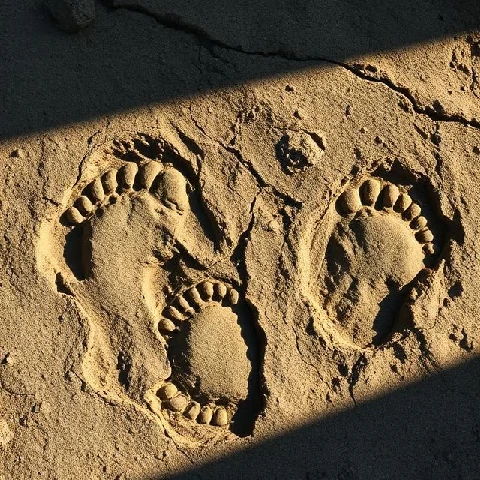
Walking on two legs is one of the defining traits of the human lineage. Bipedalism appeared in hominins millions of years before large brains or stone tools. The fossil evidence, including footprints at Laetoli in Tanzania and the pelvis of Lucy, shows that early hominins were upright walkers while still spending time in trees. The shift did not happen all at once. It was a gradual remodeling of the skeleton over millions of years.
Why it happened remains debated. Some researchers point to climate change: as forests shrank and savannas expanded, walking between patches of trees became efficient. Others suggest it freed the hands for carrying food, tools, or infants. Another idea is that standing tall reduced heat exposure in open sun. These explanations are not mutually exclusive.
Anatomical signs
- A pelvis that is short and bowl-shaped rather than long and flat.
- A spine with an S-curve that positions the head over the hips.
- Leg bones angled inward, bringing the feet under the body's center.
- A big toe aligned with the others instead of opposable.
Bipedalism is not unique to humans, but among primates it is rare. It set the stage for everything that followed.
Comments
No comments yet. Be the first to share a thought.
Leave a comment