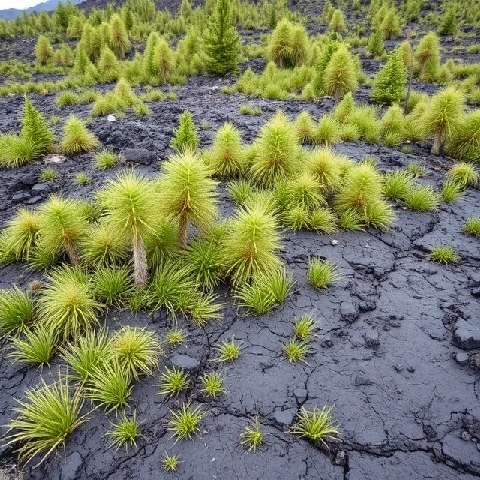
Primary succession begins on lifeless terrain. There is no soil, no seeds, no organic matter. Just bare rock, cooled lava, or newly exposed sand. The first organisms to arrive are pioneer species: lichens, mosses, and a few hardy plants. They break down rock, trap moisture, and build the first thin layer of soil. Over decades and centuries, more species arrive. Grasses and shrubs take root. Insects and small animals move in. Eventually, trees establish, and a forest develops.
Primary succession is slow. It can take hundreds or thousands of years. The exact path depends on climate, the type of substrate, and what species are nearby. Two famous examples are the volcanic slopes of Mount St. Helens after the 1980 eruption, and the islands formed by Surtsey off Iceland in the 1960s. Scientists have monitored both closely, watching how life colonizes new ground. The process is not linear. Disturbances like fires or landslides can reset parts of the sequence.
Stages of primary succession
- Bare substrate: no soil or life.
- Pioneer species: lichens, mosses, hardy plants.
- Intermediate: grasses, shrubs, small trees.
- Late stage: mature forest or climax community.
Primary succession is one of the clearest demonstrations that ecosystems are not fixed. They build themselves from nothing, given enough time.
Comments
No comments yet. Be the first to share a thought.
Leave a comment