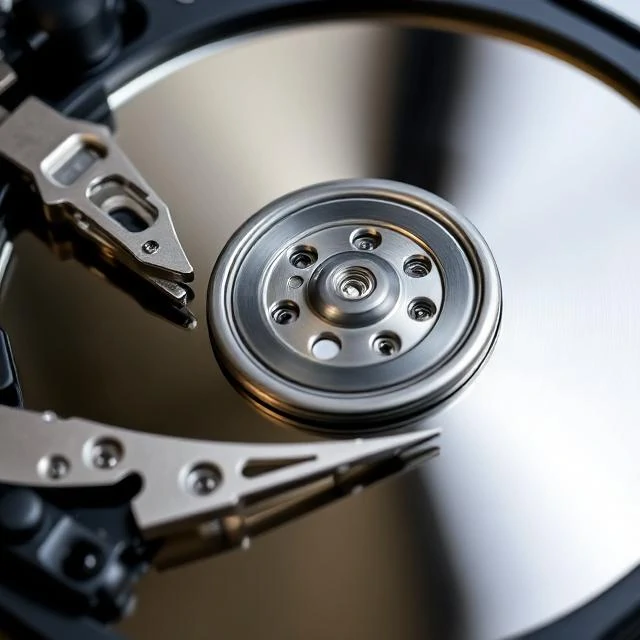
A hard drive stores digital data on rotating magnetic platters. The platters spin at thousands of revolutions per minute. A read/write head floats nanometers above the surface, reading and writing magnetic patterns. The technology has been refined for decades. Capacity grew from megabytes in the 1980s to terabytes today. Cost per gigabyte dropped dramatically. Hard drives remain the cheapest option for bulk storage.
The mechanics create limits. Moving parts wear out. A head crash can destroy data instantly. Access times are measured in milliseconds, which is slow compared to solid-state drives. Vibration and shock can damage the drive during operation. Despite these weaknesses, hard drives persist because they are cheap. Data centers use them for backup, archiving, and cold storage. Consumers use them for media libraries and external backups. A 20-terabyte hard drive costs less than a 4-terabyte SSD. For workloads where speed is not critical, the economics favor spinning disks. The technology is not standing still. Helium-filled drives reduce friction and increase capacity. Shingled magnetic recording packs tracks closer together. Heat-assisted magnetic recording uses lasers to write smaller bits. Each advance extends the life of the hard drive. It will not last forever. But it is not dead yet.
Hard drive characteristics
- Capacity — up to 20+ terabytes per drive
- Speed — 5,400 to 15,000 RPM, slower than SSD
- Cost — cheapest per gigabyte
- Durability — vulnerable to shock and wear
- Use cases — bulk storage, backup, archives
The hard drive is old technology that keeps getting better. It is not fast. It is cheap. That is enough for most storage.
Comments
No comments yet. Be the first to share a thought.
Leave a comment