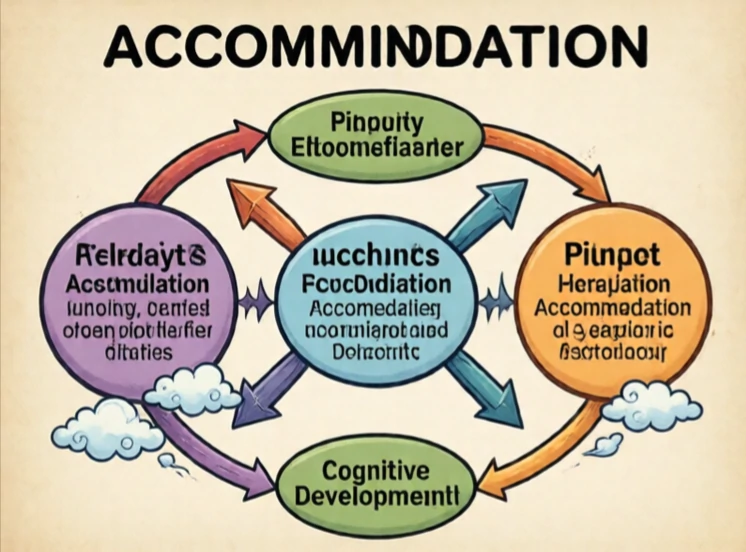
Accommodation is Jean Piaget's term for modifying existing cognitive schemas to incorporate new information. A schema is a mental framework. It organizes knowledge. When new information does not fit, the child must change the schema. That change is accommodation. It is how learning happens.
Piaget described two processes: assimilation and accommodation. Assimilation fits new information into existing schemas. A child sees a zebra and calls it a horse. The schema for horse is used. Accommodation changes the schema. The child learns that zebras have stripes. A new schema is created. The two processes work together. They drive cognitive development.
Examples of accommodation
- Learning that a whale is a mammal, not a fish.
- Adjusting a schema of dog to include different breeds.
- Learning that not all flying animals are birds.
- Changing a schema of family to include blended families.
- Understanding that a square is a rectangle.
Accommodation is essential for learning. Without it, schemas stay rigid. The child cannot understand new things. Accommodation is harder than assimilation. It requires changing what you know. It can be uncomfortable. Piaget argued that cognitive development proceeds through stages. Each stage involves accommodation. The child moves from simple schemas to complex ones. The process is active. The child constructs knowledge. It is not passive absorption. The child experiments, questions, and revises. Accommodation is the revision. It is the engine of intellectual growth. Teachers can support it by presenting challenges. Disequilibrium motivates accommodation. The child wants to restore balance. That desire drives learning. Accommodation is not just for children. Adults accommodate too. Learning a new language, a new job, or a new culture requires changing schemas. It is a lifelong process. Piaget gave us the vocabulary to describe it.
Comments
No comments yet. Be the first to share a thought.
Leave a comment