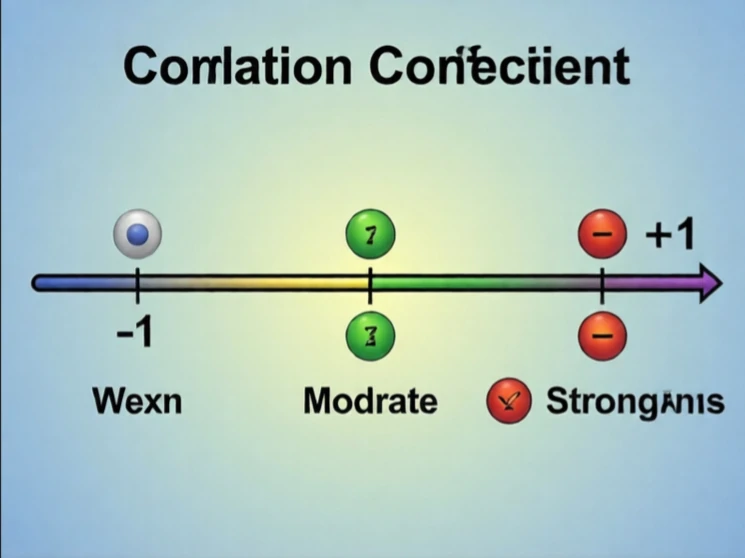
The correlation coefficient is a single number that summarizes the direction and strength of a linear relationship between two variables. It ranges from -1.00 to +1.00.
A value of +1.00 indicates a perfect positive relationship: every increase in one variable is matched by a proportional increase in the other. A value of -1.00 indicates a perfect negative relationship. A value of 0 indicates no linear relationship at all. In practice, most psychological correlations fall somewhere between these extremes. A coefficient of .30 or .40 is often considered moderate; coefficients above .70 are strong.
The most common measure is Pearson’s r, which assumes interval data and linear relationships. Other coefficients exist for ranked data or non-linear patterns. Squaring the coefficient yields the proportion of variance shared by the two variables, a useful way to gauge practical importance.
Reporting the coefficient alongside a scatterplot gives a clearer picture than either alone. The number quantifies what the eye can only estimate.
Comments
No comments yet. Be the first to share a thought.
Leave a comment