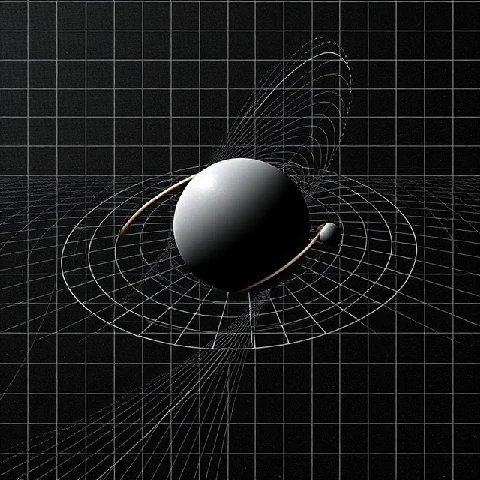
Relativity is Einstein's theory of space, time, and gravity. It comes in two parts. Special relativity, published in 1905, deals with objects moving at constant speeds, especially speeds close to the speed of light. General relativity, published in 1915, deals with acceleration and gravity. Together, they revolutionized physics. They replaced Newton's absolute space and time with a flexible spacetime that bends and stretches. They predicted phenomena that Newton's theory could not explain, from the precession of Mercury's orbit to the existence of black holes.
Special relativity rests on two postulates. The laws of physics are the same for all observers in uniform motion. The speed of light in a vacuum is the same for all observers, regardless of their motion. From those postulates come time dilation, length contraction, and the equivalence of mass and energy, E = mc². General relativity extends the theory to accelerating frames and gravity. It describes gravity not as a force but as the curvature of spacetime. Mass and energy curve spacetime, and objects follow the straightest possible paths through that curved geometry. Relativity has been confirmed by countless experiments. It is essential for GPS, particle accelerators, and cosmology.
Relativity facts
- Special relativity. 1905, constant speeds.
- General relativity. 1915, acceleration and gravity.
- Postulates. Physics is the same for all inertial observers. Speed of light is constant.
- Consequences. Time dilation, length contraction, E = mc².
- Gravity. Curvature of spacetime.
Relativity is not the same as relativism. Relativity is a physics theory. Relativism is a philosophical position about truth and morality.
Comments (2)
Leave a comment