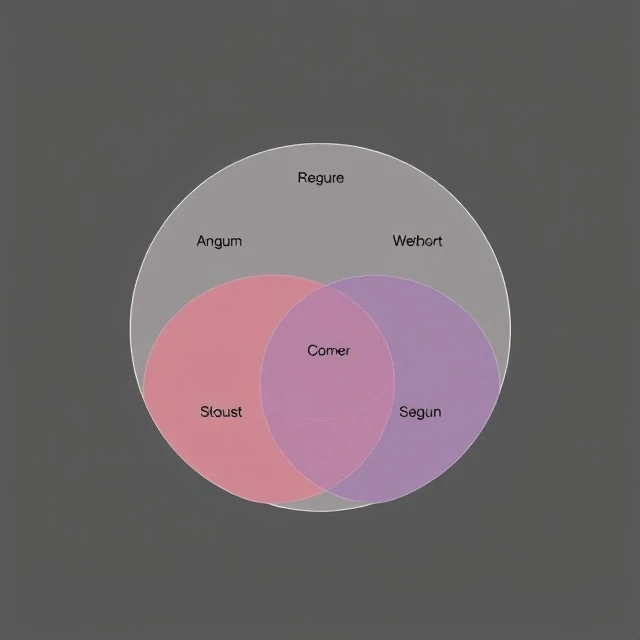
A set is a collection of distinct objects. The objects are elements. A set can be listed: {1, 2, 3}. Or described: the set of even numbers. Sets can be finite or infinite. The empty set, denoted ∅, has no elements.
Set theory, developed by Cantor in the nineteenth century, became the foundation of modern mathematics. Operations include union, intersection, difference, and complement. Venn diagrams visualize these operations.
Sets appear throughout mathematics. Functions map sets to sets. Probability uses sample spaces. Logic uses sets of truth values. In computer science, sets are data structures. The concept is simple but fundamental to nearly every branch of mathematics.
- Collection of distinct objects
- Elements are the objects
- Operations: union, intersection, complement
- Foundation of modern mathematics
Comments
No comments yet. Be the first to share a thought.
Leave a comment