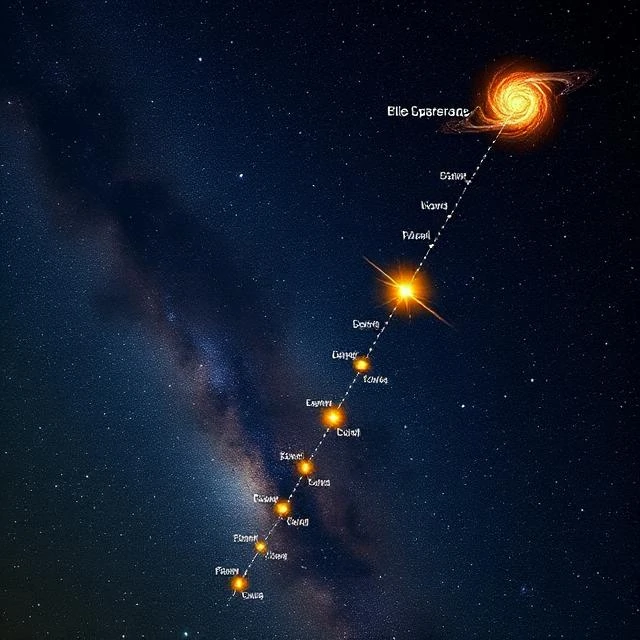
Astronomers cannot stretch a tape measure to the stars. They build a ladder instead. The cosmic distance ladder is a series of methods, each calibrated by the one below it. No single technique works across all distances. Together they reach from the Moon to the edge of the observable universe.
The first rung is parallax. Earth's orbit shifts our view of nearby stars, and that shift gives their distance. Parallax works out to about 10,000 light-years. The next rung uses Cepheid variables and RR Lyrae stars, whose periods reveal their true brightness. The third rung uses Type Ia supernovae, which are bright enough to be seen across billions of light-years.
Each rung depends on the one below it. If the calibration is wrong, everything above it is wrong too. That is why astronomers argue about the Hubble constant. Different methods give slightly different answers, and the discrepancy, called the Hubble tension, may point to new physics.
The ladder is not a perfect metaphor. It is more like a chain of assumptions, each tested and retested. When one link breaks, the whole chain is suspect.
Comments
No comments yet. Be the first to share a thought.
Leave a comment