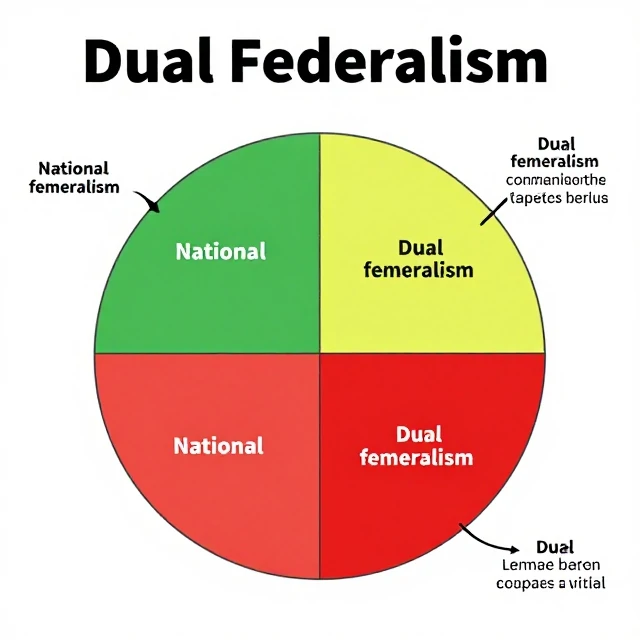
Dual federalism is a model in which national and state governments operate in separate spheres of authority. Each level has its own responsibilities. The national government handles foreign policy, defense, and interstate commerce. The states handle education, health, and local law enforcement. The spheres are distinct. They do not overlap much. The model is also called layer-cake federalism.
The model dominated American government from the founding until the New Deal. The Supreme Court enforced the separation. It struck down federal laws that intruded on state powers. The Commerce Clause was interpreted narrowly. The Tenth Amendment reserved powers to the states. The system was decentralized. States were laboratories of democracy. They experimented with policies. The national government stayed out.
Dual federalism characteristics
- Separate spheres of authority.
- Limited overlap between levels.
- Strict interpretation of the Commerce Clause.
- States' rights and local control.
- Layer-cake metaphor.
Dual federalism eroded during the Great Depression. The New Deal expanded federal power. The Supreme Court changed its interpretation. The Commerce Clause became a broad grant of authority. Federal programs reached into education, health, and welfare. The layers blended. Cooperative federalism replaced dual federalism. The national and state governments worked together. They shared responsibilities. The marble cake replaced the layer cake. Dual federalism is now mostly historical. But it still influences debates. Calls for states' rights echo dual federalism. Debates over the Affordable Care Act, marijuana legalization, and sanctuary cities are debates about federalism. The question is always the same: who decides? The national government or the states? Dual federalism gave the answer: both, in their own spheres. The spheres are not as separate as they used to be. But the idea persists. It is a vision of limited government. It is a vision of divided power.
Comments
No comments yet. Be the first to share a thought.
Leave a comment