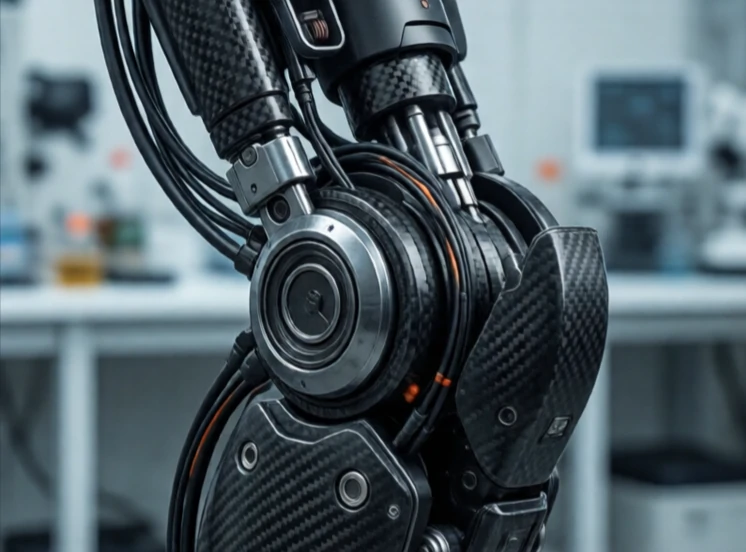
A joint connects two links in a robot and allows relative motion. It is the axis of movement. A revolute joint rotates. A prismatic joint slides. A spherical joint rotates in multiple directions. The type and arrangement of joints determine what the robot can do.
Each joint has a range of motion, a maximum speed, and a torque limit. A robot arm with six revolute joints can position and orient its end effector anywhere in its workspace. A robot with fewer joints is limited. The joint is where the motor, gearbox, encoder, and bearing come together. It is the most complex mechanical assembly in most robots.
Common joint types
- Revolute: rotates around a single axis, like an elbow.
- Prismatic: slides linearly, like a drawer.
- Spherical: rotates in three axes, like a shoulder.
- Universal: two axes, like a wrist.
- Helical: combines rotation and translation, like a screw.
Joint design is a trade-off. More joints mean more flexibility but also more weight, cost, and control complexity. Backlash in the gearbox reduces precision. Flex in the links reduces stiffness. Cable routing through joints is a packaging nightmare. Engineers spend months designing a single joint for a humanoid robot, trying to fit motor, gearbox, encoder, bearing, and wiring into a package the size of a human knee. The joint is small, but it is where the robot's capability is born.
Comments
No comments yet. Be the first to share a thought.
Leave a comment