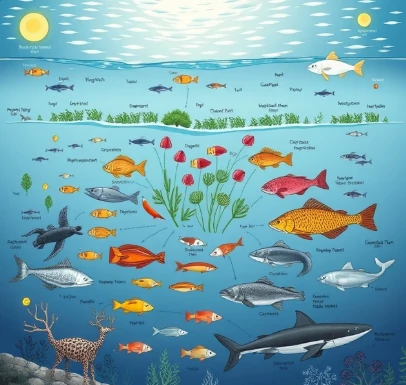
Energy and materials in the ocean do not move along single chains; they flow through interconnected networks of who eats whom. These networks are food webs. Phytoplankton and other primary producers form the base; zooplankton, small fish, larger predators, and detritivores occupy higher levels, with many species feeding at more than one level.
Marine food webs are shaped by size, behavior, and the availability of light and nutrients. Microbial loops recycle dissolved organic matter that would otherwise be lost. Trophic cascades occur when changes at one level propagate to others—for example, when overfishing of large predators releases mid-level consumers that then suppress herbivores.
Understanding food-web structure helps predict the consequences of fishing, climate change, and invasive species. Stable isotopes, gut contents, and network models are common tools for mapping links. Protecting key nodes and maintaining diversity within the web increases the resilience of marine ecosystems to disturbance.
- Network of feeding relationships
- Based on primary producers and multiple consumer levels
- Includes microbial recycling pathways
- Sensitive to fishing and environmental change
Comments
No comments yet. Be the first to share a thought.
Leave a comment