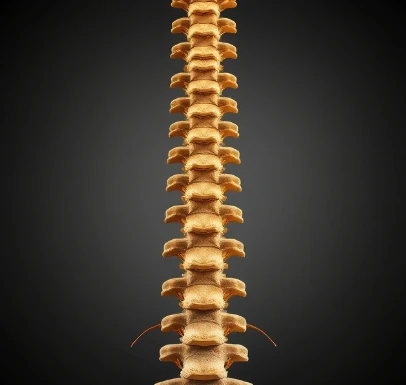
Encased in the vertebral column, the spinal cord is a cylindrical continuation of the brainstem that both conducts signals between body and brain and contains local circuits capable of generating reflexes and rhythmic motor patterns.
Sensory axons enter dorsally; motor axons exit ventrally. Ascending tracts carry sensory information to the brain; descending tracts convey motor commands and modulatory signals. Segmental organization means that each level of the cord innervates a specific region of the body, allowing precise clinical localization of lesions. Central pattern generators within the cord can produce locomotion-like output even when isolated from the brain.
Injury interrupts the long tracts and produces paralysis and sensory loss below the level of damage, often accompanied by exaggerated reflexes once spinal shock subsides. Because regeneration in the central nervous system is limited, spinal-cord injury remains a major cause of permanent disability. Research into neuroprotection, regeneration, and brain-computer interfaces seeks to restore function after such injuries.
- Conducts signals between brain and body
- Contains reflex and pattern-generating circuits
- Segmentally organized
- Vulnerable to traumatic injury with lasting consequences
Comments
No comments yet. Be the first to share a thought.
Leave a comment