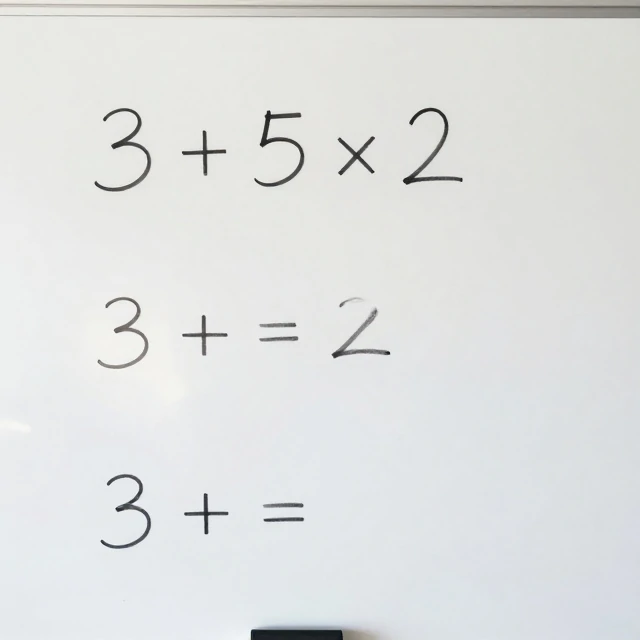
A numerical expression is a mathematical phrase that contains only numbers and operations. No variables. 3 + 5 times 2 is a numerical expression. 7 minus 4 divided by 2 is another. It can be evaluated to a single number. The order of operations determines the result.
PEMDAS is the rule. Parentheses first. Exponents next. Multiplication and division from left to right. Addition and subtraction from left to right. 3 + 5 times 2 equals 3 + 10, which is 13. If you did addition first, you would get 16, which is wrong. The order matters.
Evaluating numerical expressions
- Simplify inside parentheses first.
- Evaluate exponents.
- Multiply and divide left to right.
- Add and subtract left to right.
- The result is a single number.
A numerical expression has no equal sign. It is not an equation. It is a phrase, not a sentence. An equation has an equal sign and states that two expressions are equal. A numerical expression is just a calculation waiting to be performed. You evaluate it. You do not solve it. The distinction matters in algebra. An expression can be simplified. An equation can be solved. A numerical expression simplifies to a number. There is nothing to solve. It is a recipe. The numbers are ingredients. The operations are instructions. Follow the order and you get the result. Skip a step or change the order and you get a different result. That is why PEMDAS exists. It is the grammar of arithmetic.
Comments
No comments yet. Be the first to share a thought.
Leave a comment