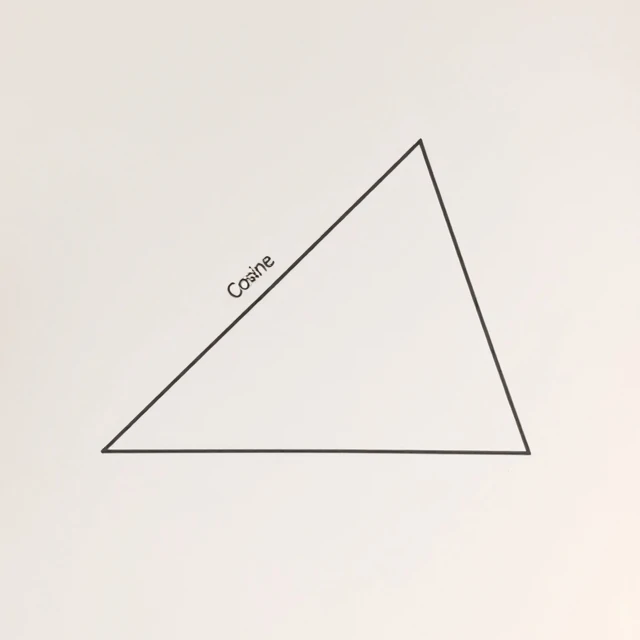
In a right triangle, the cosine of an angle is the length of the adjacent side divided by the hypotenuse. For a 60-degree angle in a standard triangle, the cosine is 0.5. The function extends beyond right triangles through the unit circle.
Cosine is one of the three basic trigonometric functions, alongside sine and tangent. It describes periodic motion, wave behavior, and rotations. The graph of cosine is a smooth wave that repeats every 360 degrees, or 2π radians.
The law of cosines generalizes the Pythagorean theorem to any triangle: c² = a² + b² − 2ab cos(C). Cosine also appears in Fourier analysis, where complex signals are broken into cosine and sine components. Engineers use it to analyze alternating current, sound, and vibration. The function is fundamental to any field that deals with waves or angles.
- Ratio of adjacent side to hypotenuse
- Periodic function with period 2π
- Appears in the law of cosines
- Central to Fourier analysis and wave physics
Comments
No comments yet. Be the first to share a thought.
Leave a comment