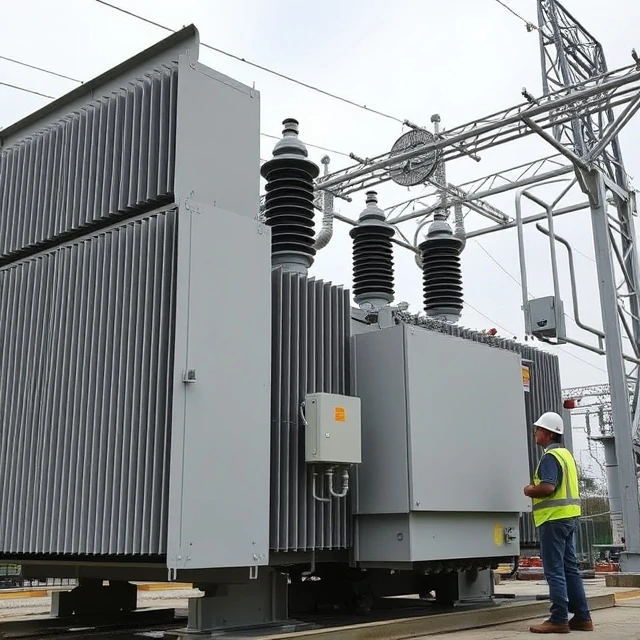
A transformer changes the voltage of alternating current. It has two coils of wire wrapped around a magnetic core. When current flows through one coil, it creates a magnetic field. That field induces current in the second coil. The ratio of turns in the two coils determines whether voltage goes up or down.
Transformers are everywhere on the grid. Step-up transformers at power plants raise voltage to hundreds of thousands of volts for transmission. Step-down transformers at substations lower it for distribution. Small transformers on poles or in basements bring it down to the 120 or 230 volts that homes use.
They are efficient, often above 98 percent. They have no moving parts and last decades. But they are not perfect. Some energy is lost as heat. Large transformers use oil for cooling and insulation. That oil can leak or catch fire. Utilities monitor transformers closely because a failure can black out a neighborhood.
Key types
- Step-up transformers
- Step-down transformers
- Distribution transformers
- Isolation transformers
- Autotransformers
Comments
No comments yet. Be the first to share a thought.
Leave a comment