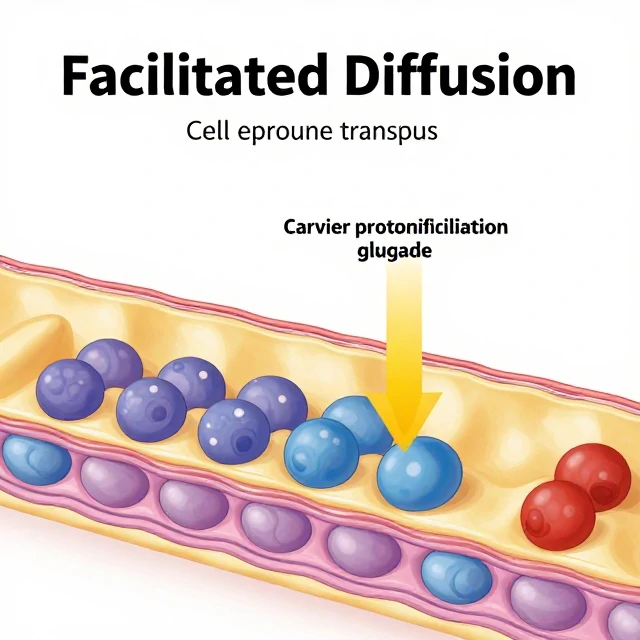
Facilitated diffusion moves molecules across a cell membrane with the help of carrier proteins. The molecules move from high concentration to low concentration, down the gradient. No energy is required. The protein is the facilitator. It provides a path through the lipid bilayer that the molecule cannot cross on its own.
Glucose enters red blood cells this way. The GLUT1 transporter binds glucose on one side of the membrane, changes shape, and releases it on the other side. The process is passive. ATP is not consumed. The direction of movement is determined by the concentration gradient. If the gradient reverses, the transport reverses.
Characteristics of facilitated diffusion
- Passive: no energy input.
- Specific: each transporter handles specific molecules.
- Saturable: transport rate plateaus when transporters are full.
- Competitive: similar molecules compete for the same transporter.
- Down the concentration gradient.
The saturation behavior distinguishes facilitated diffusion from simple diffusion. Simple diffusion increases linearly with concentration. Facilitated diffusion levels off because the number of transporter proteins is finite. When all transporters are occupied, adding more molecules does not increase the rate. That is why glucose uptake by cells plateaus at high blood glucose levels. The transporter is the bottleneck. Some transporters are gated, opening only in response to a signal. Insulin triggers GLUT4 transporters to move to the cell membrane, increasing glucose uptake. That is how the body regulates blood sugar. Facilitated diffusion is passive, but it is not uncontrolled. The cell decides which transporters to express and when to deploy them.
Comments
No comments yet. Be the first to share a thought.
Leave a comment