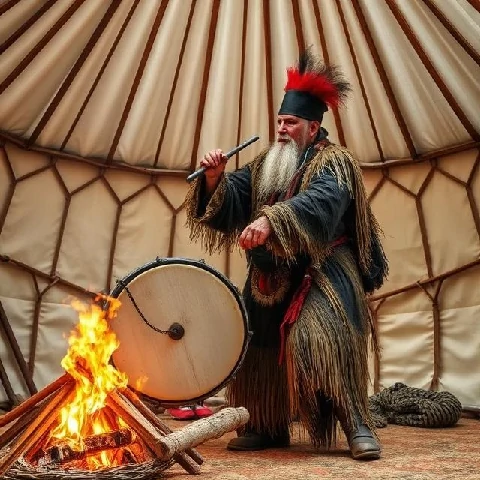
Across Siberia, the Americas, and parts of Asia and Africa, certain individuals have long served as intermediaries between the human community and the spirit world. The term shaman, borrowed from the Tungus of Siberia, has become the general label for this role. A shaman enters altered states of consciousness—through drumming, dancing, fasting, or psychoactive plants—in order to journey, retrieve information, heal, or negotiate with spirits.
The calling is often marked by a crisis: illness, dreams, or a near-death experience that signals selection by the spirits. Training follows, sometimes under an older practitioner, sometimes through solitary ordeal. Once recognized, the shaman performs public rituals for the benefit of the group—diagnosing the cause of misfortune, recovering lost souls, escorting the dead, or ensuring success in hunting. The cosmology is typically layered: an upper world of sky spirits, a middle world of ordinary life, and a lower world of ancestral or animal powers.
Modern interest has produced both careful ethnography and popular reinvention. Some contemporary practitioners claim continuity with indigenous traditions; others openly construct new forms. Scholars continue to debate how far the term should stretch and whether the underlying experiences point to a universal human capacity or to culturally specific techniques.
At its core, shamanism treats the boundary between the visible and the invisible as porous, and the shaman as the one who knows how to cross it.
Comments (3)
Leave a comment