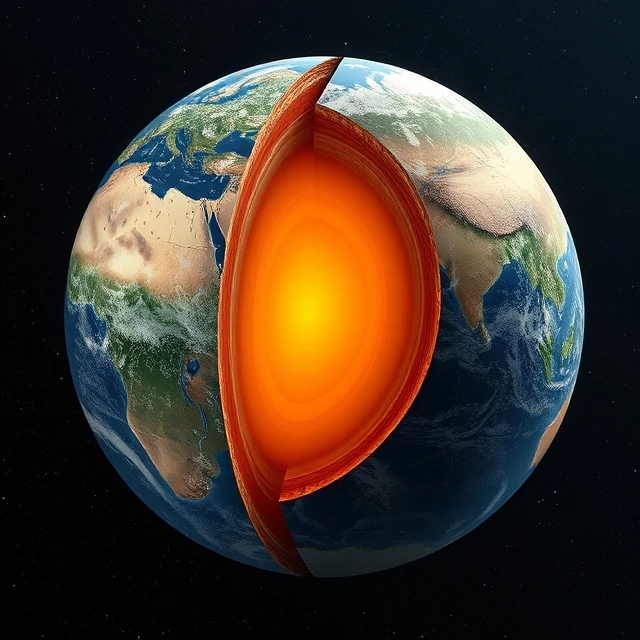
The outermost shell of Earth behaves rigidly on geologic time scales. The lithosphere comprises the crust and the uppermost mantle and is broken into the tectonic plates. Its thickness ranges from a few kilometers at mid-ocean ridges to more than 200 km beneath old continents.
Below the lithosphere lies the weaker, ductile asthenosphere. The contrast in mechanical properties allows the plates to move. Lithosphere is created at divergent boundaries and consumed at subduction zones. Continental lithosphere is generally older and more buoyant than oceanic lithosphere.
Earthquakes, volcanoes, and mountain building are largely confined to the lithosphere. Its rigidity transmits the stresses that produce faulting and folding. Mapping variations in lithospheric thickness and composition remains an active area of geophysical research.
- Rigid outer layer of crust plus upper mantle
- Broken into tectonic plates
- Overlies the ductile asthenosphere
- Created and destroyed at plate boundaries
Comments (2)
Leave a comment