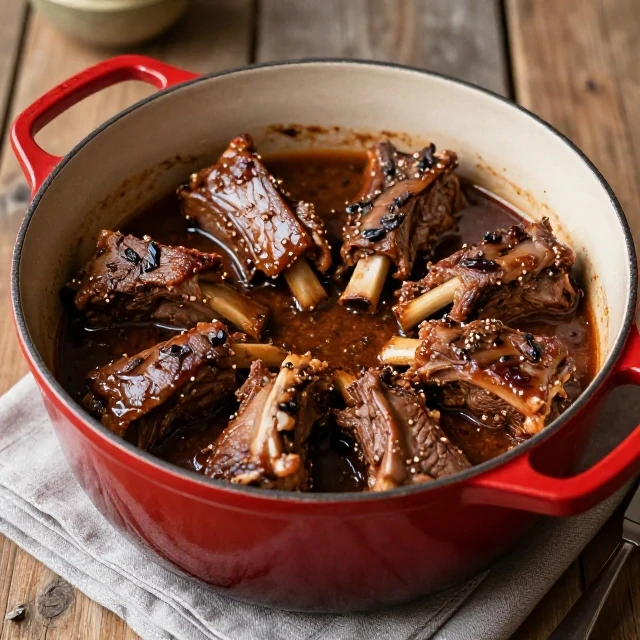
Braising cooks food slowly in a small amount of liquid in a covered pot. It combines frying and stewing. The food is first seared in fat. Then liquid is added. The pot is covered. The food cooks at low heat for a long time. The result is tender, flavorful meat. The liquid becomes a rich sauce.
Braising works best with tough cuts. Chuck roast, short ribs, pork shoulder, lamb shanks. These cuts have lots of connective tissue. Slow cooking breaks down the collagen. It turns into gelatin. That gives the meat a silky texture. The liquid, usually stock, wine, or tomato, picks up flavor from the meat. It reduces into a sauce. Pot roast is a classic braise. Coq au vin is another. Osso buco is a third.
How to braise
- Sear the meat in a hot pan with oil.
- Remove the meat and sauté aromatics.
- Add liquid, usually stock or wine.
- Return the meat to the pot and cover.
- Cook low and slow, either on the stove or in the oven.
Braising is a technique of transformation. A cheap, tough cut becomes a luxurious meal. The long cooking time develops deep flavor. The house fills with aroma. The meat falls apart with a fork. The sauce is rich and glossy. Braising is not fast. It takes hours. But most of that time is hands-off. You can braise on a Sunday afternoon. You can braise for a dinner party. You can braise in a Dutch oven or a slow cooker. The principle is the same. Low heat, covered pot, patience. Braising is the art of turning the humble into the sublime. It is cooking as alchemy. It is one of the oldest techniques in the kitchen. It is still one of the best.
Comments (3)
Leave a comment