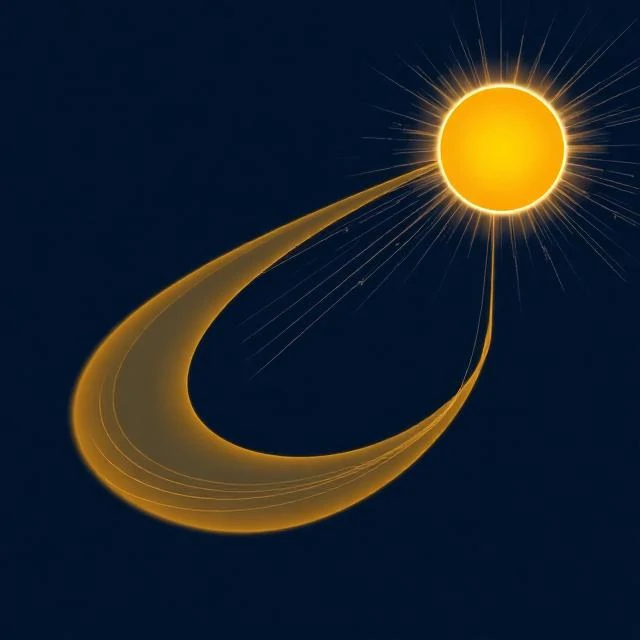
The Sun does not just radiate light. It also streams a constant flow of charged particles into space. That flow is the solar wind. It consists mostly of electrons and protons, with a few heavier ions, traveling at hundreds of kilometers per second. It carries the Sun's magnetic field with it, creating a bubble called the heliosphere that extends far beyond Pluto.
The solar wind shapes the entire solar system. It blows comet tails away from the Sun. It carves out the magnetospheres of planets. It creates auroras when it interacts with Earth's magnetic field. It also erodes planetary atmospheres over billions of years. Mars lost its atmosphere partly because the solar wind stripped it away after the planet's magnetic field shut down.
The wind is not steady. It varies with the Sun's activity cycle, which peaks every 11 years. Coronal holes, regions of open magnetic field, produce fast wind streams. Coronal mass ejections produce powerful gusts. When a fast stream catches up with a slow one, it creates a co-rotating interaction region that can trigger geomagnetic storms.
The solar wind eventually slows and mixes with the interstellar medium at the heliopause. Voyager 1 crossed that boundary in 2012, becoming the first spacecraft to enter interstellar space.
Comments
No comments yet. Be the first to share a thought.
Leave a comment