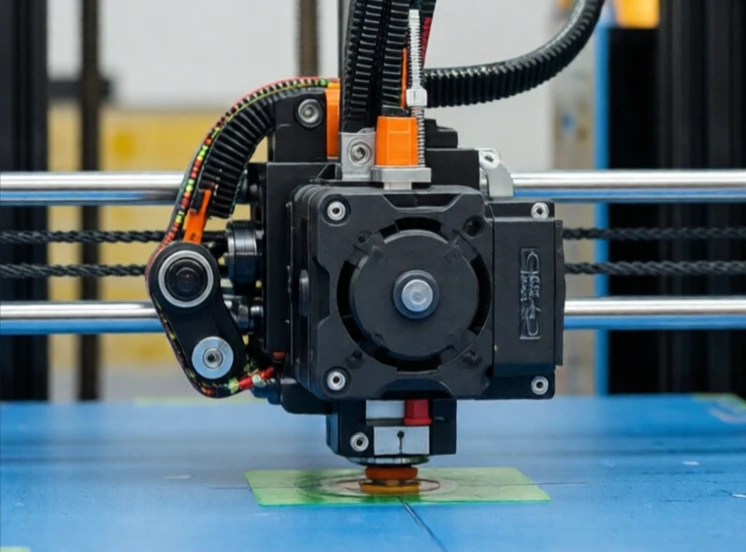
A stepper motor rotates in discrete steps. Send one pulse and it turns one step. Send 200 pulses and it turns one full revolution. The motor does not need an encoder to know its position. The controller counts the pulses. That simplicity makes stepper motors popular in 3D printers, CNC machines, and small robots.
Stepper motors have multiple coils. The controller energizes them in sequence. The rotor aligns with the energized coil, then moves to the next as the sequence advances. The step angle depends on the motor design. Common step angles are 1.8 degrees and 0.9 degrees, corresponding to 200 or 400 steps per revolution.
Stepper motor characteristics
- Open-loop position control: no encoder needed.
- High torque at low speed.
- Low cost and simple control.
- Can lose steps under overload.
- Efficiency drops at high speed.
The main weakness is step loss. If the load is too high or the acceleration too fast, the motor skips a step. The controller does not know, because there is no feedback. The position is wrong from that point on. That is why stepper motors are used for tasks where occasional position errors are acceptable, or where the load is predictable. Some systems add an encoder to detect step loss and correct it. Others use a closed-loop stepper, which combines the simplicity of a stepper with the reliability of a servo. Stepper motors are not as precise or efficient as servo motors, but they are cheap and easy to use. For many applications, that is enough.
Comments
No comments yet. Be the first to share a thought.
Leave a comment