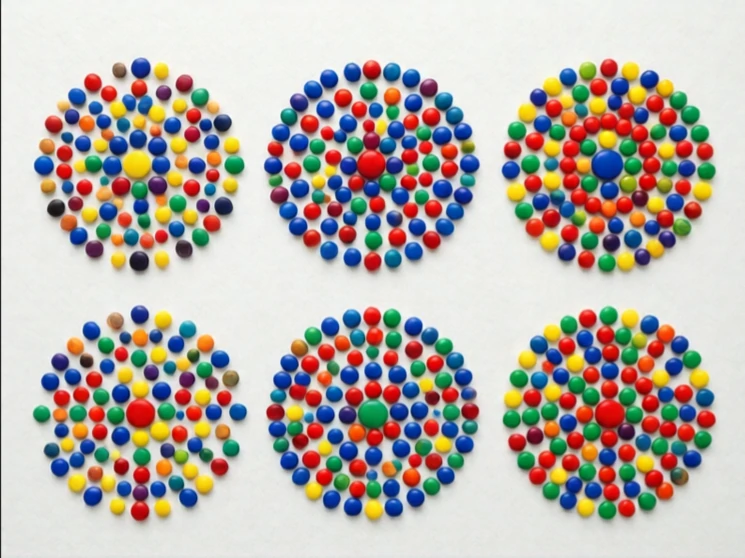
Grouping is the perceptual tendency to organize discrete stimuli into coherent, larger units. The visual system does not treat every edge and patch as independent; it binds them according to regularities in the environment.
Gestalt psychologists described several grouping principles. Elements that are close together are grouped by proximity. Elements that share color, shape, or orientation are grouped by similarity. Elements that form a continuous smooth path are grouped by continuity. Elements that move together are grouped by common fate. Closed or nearly closed shapes are grouped by closure. These principles operate rapidly and largely outside awareness, producing the objects and surfaces we experience.
Grouping is not infallible. Camouflage exploits it by making an object’s parts group with the background rather than with one another. Illusory contours arise when grouping principles complete shapes that are not fully present in the image. Modern computational models of vision incorporate many of the same regularities the Gestalt psychologists identified.
Seeing objects rather than a scatter of features is the work of grouping.
Comments
No comments yet. Be the first to share a thought.
Leave a comment