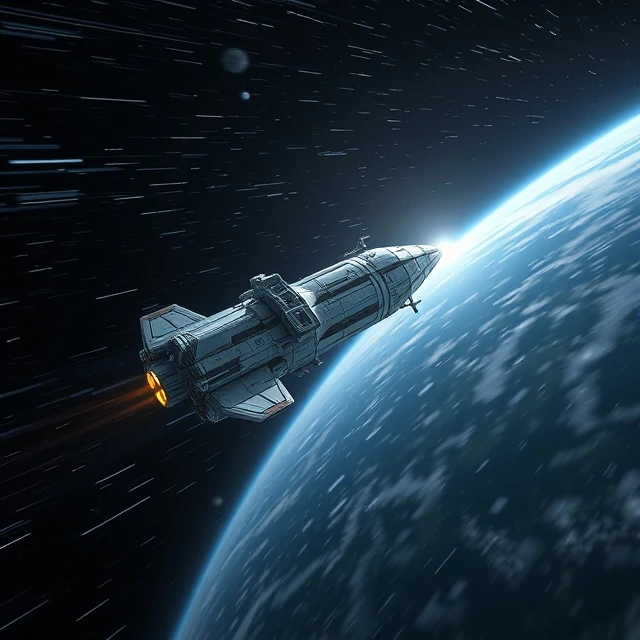
An object at rest stays at rest. An object in motion stays in motion at constant velocity. That is Newton's first law of motion, also called the law of inertia. It sounds simple, but it was revolutionary. Before Newton, people thought that a force was needed to keep an object moving. Galileo had already challenged that idea, but Newton made it a law. The reason objects on Earth slow down is friction, not a lack of force. In space, where there is no friction, a spacecraft can coast for years without firing its engines.
The first law defines what we mean by force. A force is what changes an object's state of motion. If an object is at rest and stays at rest, or moves at constant velocity, then the net force on it is zero. If it accelerates, or changes direction, then a net force is acting. The first law also introduces the concept of inertia, the resistance of an object to changes in its motion. Inertia depends on mass. A heavy object has more inertia than a light one. That is why it is harder to push a car than a bicycle, and harder to stop a train than a car.
Key points
- Law of inertia. Objects resist changes in motion.
- No force needed. Motion continues without a force.
- Net force. Zero net force means constant velocity.
- Friction. The reason objects on Earth slow down.
- Inertia. Depends on mass.
Newton's first law is not the same as Newton's second law. The first law defines force. The second law quantifies it.
Comments (2)
Leave a comment