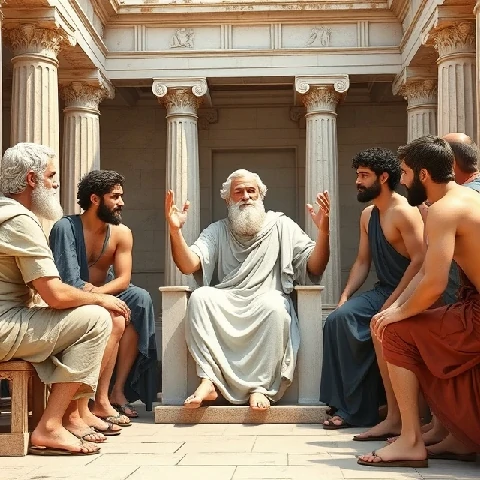
Socrates wrote nothing. We know him through Plato's dialogues, where he appears as a questioner who exposes the ignorance of his interlocutors. The Socratic method is that practice: asking questions to stimulate critical thinking and to draw out underlying assumptions. It is not about winning arguments. It is about inquiry. Socrates claimed to know nothing, and his questions were designed to show others that they knew less than they thought. The result was often aporia, a state of puzzlement, which Socrates treated as the beginning of wisdom.
The method has several steps. Ask a question about a concept, such as justice or courage. Receive an answer. Ask for a definition. Test the definition against counterexamples. Revise the definition. Repeat. The process can be uncomfortable, especially for those who thought they knew the answers. But it is also liberating. It frees the mind from unexamined opinions. The Socratic method is used in law schools, where professors question students to sharpen their reasoning. It is used in education, where teachers guide students to discover ideas for themselves. It is used in therapy, where clients are encouraged to question their own assumptions. It is a method of inquiry, not a body of doctrine.
Features of the Socratic method
- Questioning. Asking rather than telling.
- Refutation. Testing definitions against counterexamples.
- Aporia. The state of puzzlement that precedes insight.
- Humility. Acknowledging one's own ignorance.
The Socratic method is not the same as the Socratic paradox. The method is a practice. The paradox is the claim that virtue is knowledge and that no one does wrong willingly.
Comments
No comments yet. Be the first to share a thought.
Leave a comment