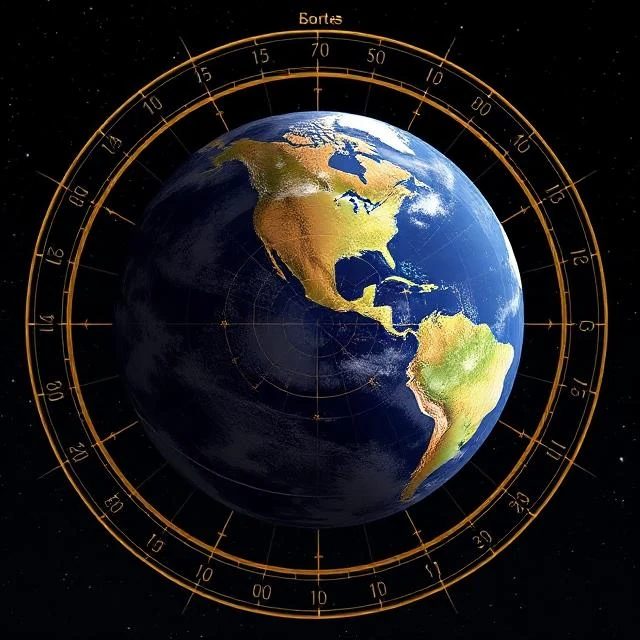
On Earth, the equator is the great circle midway between the poles. On the sky, the celestial equator is the projection of Earth's equator onto the celestial sphere. It divides the sky into northern and southern halves, just as Earth's equator divides the globe.
The celestial equator is a reference line for coordinates. Declination is measured from it. A star on the celestial equator has a declination of 0 degrees. The celestial equator intersects the horizon at due east and due west for observers anywhere on Earth. That makes it a useful marker for finding your bearings at night.
The celestial equator is not fixed. Earth's axis wobbles, a motion called precession, which shifts the celestial poles and the equator in a circle over about 26,000 years. The equinoxes, where the ecliptic crosses the celestial equator, also drift slowly westward along the ecliptic.
For observers at Earth's equator, the celestial equator passes directly overhead. That means all stars are visible at some point during the year. From the poles, the celestial equator lies exactly on the horizon. Where you stand on Earth determines what you can see.
Comments
No comments yet. Be the first to share a thought.
Leave a comment