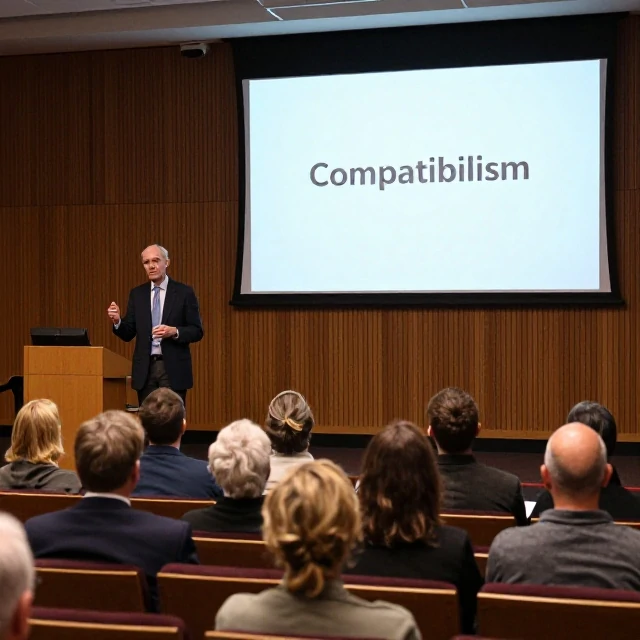
Compatibilism is the view that free will and determinism are compatible. Determinism says every event is caused by prior events. Free will says humans can make genuine choices. Compatibilists argue that these two ideas do not conflict. Free will is not the absence of causation. It is the ability to act according to one's own desires and intentions.
The debate goes back to ancient Greece. Stoics were compatibilists. They believed in fate and in human responsibility. Modern compatibilists include Hobbes, Hume, and Daniel Dennett. They redefine free will. Free will does not require the ability to do otherwise. It requires the ability to do what you want. If you want to raise your hand and you raise it, you acted freely. It does not matter that your want was caused by prior events.
Compatibilist arguments
- Free will is acting according to one's desires.
- Determinism does not eliminate choice.
- Moral responsibility requires intention, not uncaused action.
- Libertarian free will is incoherent.
- Compatibilism reconciles science and ethics.
Compatibilism is the majority view among philosophers. It avoids the extremes of hard determinism and libertarian free will. Hard determinists say free will is an illusion. Libertarians say free will requires uncaused action. Compatibilists say both are wrong. Free will is real, but it is not magical. It is the capacity to deliberate and choose. The causes of your choice are your reasons, your desires, your character. Those causes are part of you. If they were not, the choice would not be yours. Compatibilism is a middle path. It accepts science and preserves ethics. It says you can be free even in a determined world. That is a comforting thought. It is also a controversial one.
Comments
No comments yet. Be the first to share a thought.
Leave a comment