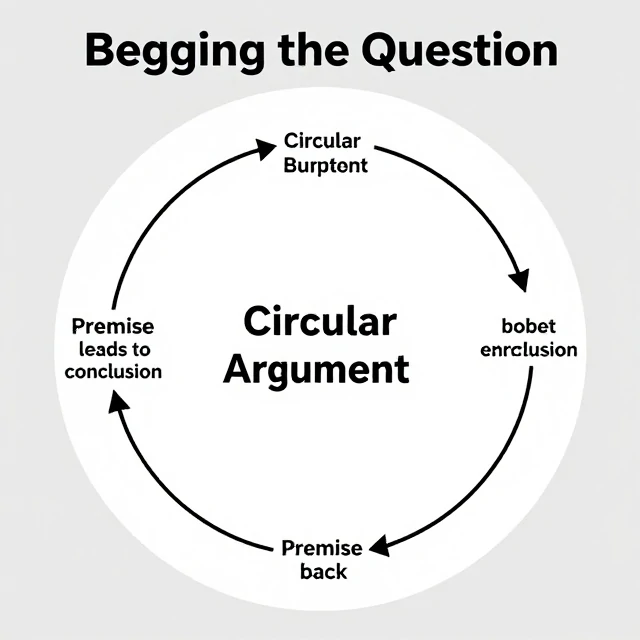
Begging the question is a fallacy where the premises assume the truth of the conclusion. The argument goes in a circle. It assumes what it is trying to prove. The conclusion is hidden in the premise. The argument is valid but useless. It does not add any new information.
The classic example: God exists because the Bible says so, and the Bible is the word of God. The premise assumes the conclusion. The argument is circular. Another example: This book is true because it says it is true. The premise assumes the conclusion. The argument proves nothing.
Begging the question examples
- Freedom of speech is important because without it we could not speak freely.
- He is trustworthy because he always tells the truth.
- This medicine works because it is effective.
- The law is just because it is legal.
- I am a good person because I do good things.
Begging the question is sometimes called circular reasoning. The two terms are often used interchangeably. Strictly speaking, begging the question is a broader category. It includes any argument where the premise assumes the conclusion. Circular reasoning is a specific form where the conclusion is used as a premise. The distinction is subtle. The fallacy is common in everyday arguments. People assume what they are trying to prove. They do not realize the argument is circular. The remedy is to ask: what evidence supports the premise? If the premise is just the conclusion restated, the argument fails. It is a closed loop. It goes nowhere. The question is begged, not answered.
Comments
No comments yet. Be the first to share a thought.
Leave a comment