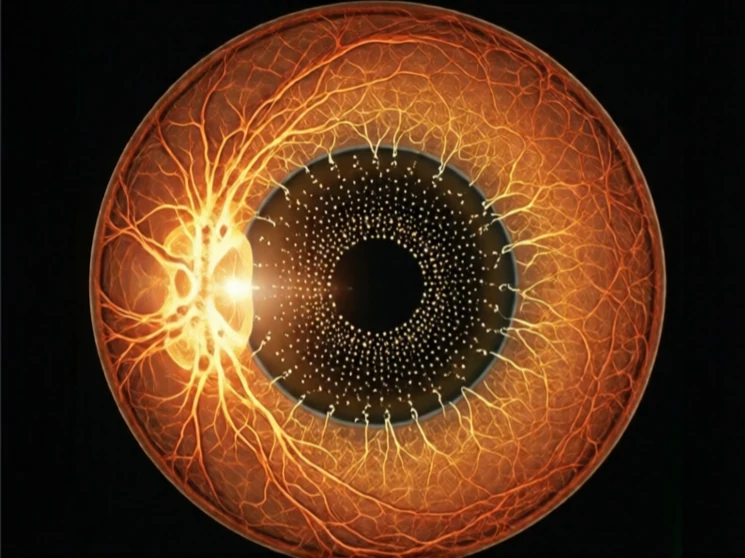
Cones are the retinal photoreceptors responsible for high-acuity vision and color discrimination. They function best in relatively bright light and are concentrated in the fovea, the central region of the retina used for detailed inspection.
Humans normally have three types of cones, each containing a photopigment sensitive to a different range of wavelengths—roughly short (blue), medium (green), and long (red). The brain compares the relative activation of the three types to construct the perception of color. Because cones are less sensitive than rods, they contribute little to vision in dim light; that is why color fades at dusk and fine detail becomes harder to resolve.
The dense packing of cones in the fovea, together with a private line from each cone to higher visual centers, gives central vision its sharpness. Away from the fovea the density drops and several receptors share each ganglion cell, reducing acuity. Color blindness most often results from the absence or abnormal function of one cone type, altering the comparisons that produce hue.
Whenever we read fine print or judge the ripeness of fruit by its color, we are relying on the cones.
Comments
No comments yet. Be the first to share a thought.
Leave a comment