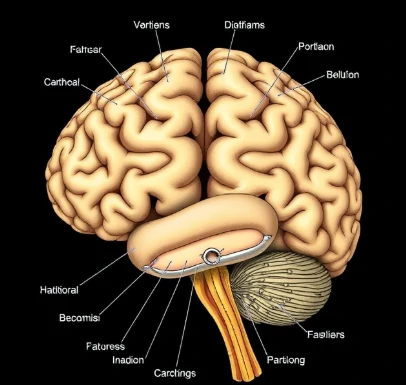
Twelve pairs of nerves emerge directly from the brain rather than from the spinal cord. These cranial nerves carry sensory information from the special senses and the head, and they innervate the muscles of the face, eyes, tongue, and throat, as well as many autonomic targets.
Each nerve has a distinct name and number, from the olfactory nerve (I) to the hypoglossal nerve (XII). Some are purely sensory, others purely motor, and several are mixed. Examination of cranial-nerve function is a standard part of the neurological work-up because focal deficits can localize lesions with high precision.
Pathways for vision, hearing, balance, taste, and facial expression all travel in cranial nerves. Damage can produce anosmia, blindness, double vision, facial paralysis, or swallowing difficulty, depending on the nerve involved. Understanding their anatomy is therefore essential for both diagnosis and surgical planning around the base of the skull and brainstem.
- Twelve pairs emerging from the brain
- Serve head, neck, and special senses
- Sensory, motor, or mixed functions
- Critical for neurological localization
Comments
No comments yet. Be the first to share a thought.
Leave a comment