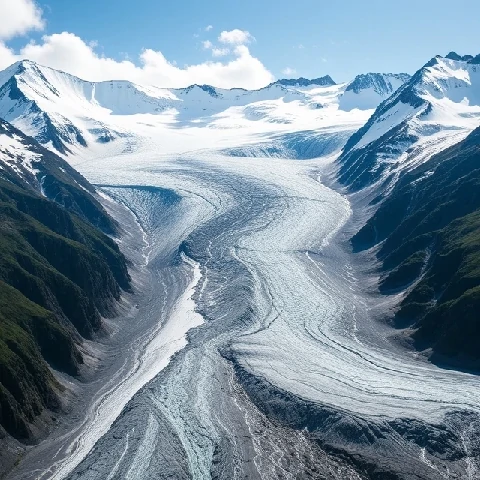
Snow that persists year after year eventually densifies into ice and begins to flow. A glacier is a persistent body of dense ice that moves under its own weight. Valley glaciers occupy mountain valleys; ice sheets bury entire landscapes.
Glaciers erode by plucking and abrasion, carving cirques, arêtes, and U-shaped valleys. They transport debris of all sizes and deposit it as till when the ice melts. Flow rates range from a few meters to several kilometers per year depending on slope, thickness, and temperature.
Most of the world’s glaciers are currently retreating as climate warms. Their meltwater contributes to sea-level rise and supplies seasonal water to many rivers. Monitoring glacier mass balance provides a sensitive indicator of climate change. The blue ice of a glacier remains one of the most striking sights in nature.
- Moving mass of dense ice
- Forms from compacted snow
- Erodes and deposits distinctive landforms
- Currently retreating in most regions
Comments
No comments yet. Be the first to share a thought.
Leave a comment