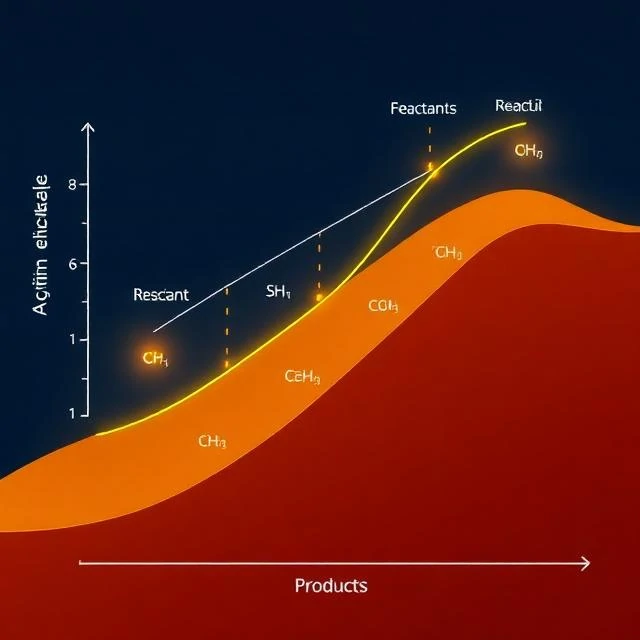
Wood does not burst into flame at room temperature. It has the fuel and the oxygen, but it lacks the spark. Activation energy is the minimum energy required to start a chemical reaction. It is the hill that reactants must climb before they can slide down to products. Without enough energy, molecules collide but do not react.
The concept comes from collision theory. Not every collision between reactant molecules leads to a reaction. Only those with enough energy and the right orientation can break existing bonds and form new ones. The activation energy is the barrier. A higher barrier means a slower reaction. A lower barrier means a faster one. Temperature raises the average kinetic energy of molecules, so more of them can clear the barrier. That is why reactions speed up when heated.
Catalysts lower activation energy by providing an alternative pathway. They do not change the overall energy balance, only the route. Enzymes are biological catalysts that lower activation energy dramatically, enabling reactions at body temperature that would otherwise require extreme conditions. The catalytic converter in a car uses platinum and palladium to lower the activation energy for converting pollutants into less harmful gases.
Activation energy is not the same as the energy change of a reaction. A reaction can release a lot of energy overall and still have a high activation energy. That is why diamonds do not spontaneously turn into graphite, even though graphite is more stable.
Comments
No comments yet. Be the first to share a thought.
Leave a comment