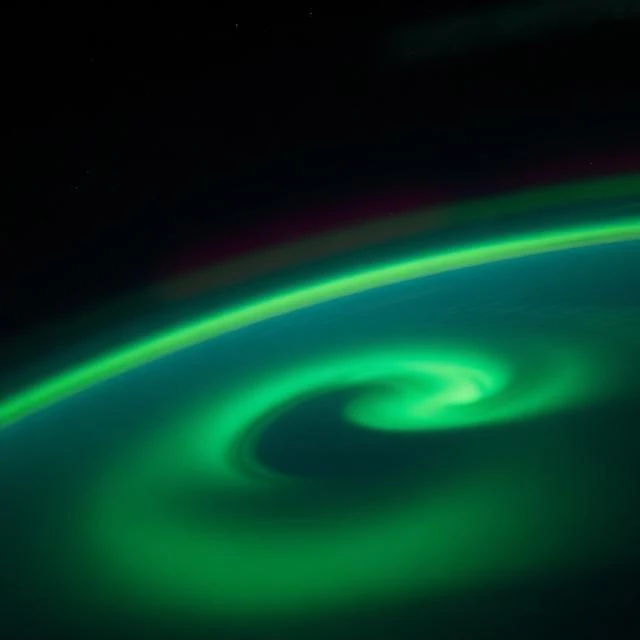
On a clear night near the poles, the sky can glow green, red, and purple. That is an aurora. It happens when charged particles from the Sun, carried by the solar wind, slam into Earth's magnetosphere. The magnetosphere funnels them toward the poles, where they collide with oxygen and nitrogen in the upper atmosphere. Those collisions excite the atoms, and as they relax, they emit light.
Green is the most common color, produced by oxygen at about 100 to 150 kilometers altitude. Red comes from oxygen higher up. Purple and blue come from nitrogen. The colors depend on which gas is hit and how high the collision occurs.
Auroras are not just pretty. They are a visible sign of space weather, the same activity that can disrupt satellites, radio communications, and power grids. The Carrington Event of 1859 caused auroras visible near the equator and knocked out telegraph systems. A similar storm today would cause far more damage.
Scientists study auroras to understand how the magnetosphere responds to solar activity. The light is the tip of a much larger phenomenon.
Comments
No comments yet. Be the first to share a thought.
Leave a comment