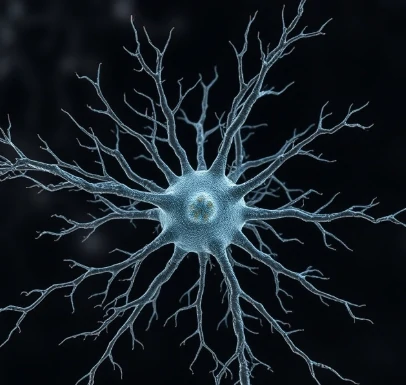
Dendrites are the branching extensions of a neuron that receive signals from other cells. Their name comes from the Greek for tree, and the resemblance is apt: a typical neuron spreads a dense arbor of dendrites that collect input from hundreds or thousands of synaptic contacts.
Chemical signals released at synapses bind to receptors on the dendritic membrane, producing small electrical changes. These local potentials travel toward the cell body, where they are summed. If the combined signal reaches threshold at the axon hillock, an action potential is triggered. Dendritic spines—tiny protrusions on the branches—are the primary sites of excitatory synapses and are highly plastic; their number and shape change with learning and experience.
The geometry of the dendritic tree influences how signals are integrated. Some neurons have elaborate, far-reaching dendrites; others are more compact. Disease processes that prune or distort dendrites, as in certain forms of intellectual disability or neurodegeneration, disrupt the neuron’s ability to process information.
Every message a neuron receives arrives first on its dendrites.
Comments
No comments yet. Be the first to share a thought.
Leave a comment