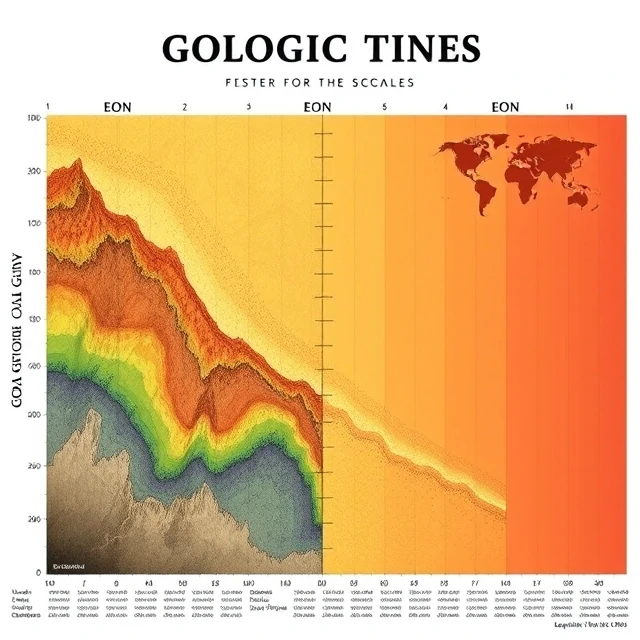
Geologic time is so vast that ordinary years become inadequate. An eon is the largest formal division of the geologic time scale, spanning hundreds of millions to billions of years. Earth’s history is divided into four eons: Hadean, Archean, Proterozoic, and Phanerozoic.
The first three together constitute the Precambrian, a span that covers roughly 88 percent of Earth history. The Phanerozoic Eon, beginning about 541 million years ago, contains the abundant fossil record of complex life. Each eon is subdivided into eras, periods, and epochs.
Defining eon boundaries relies on major changes in the rock or fossil record, such as the appearance of widespread multicellular life. Absolute ages come from radiometric dating of suitable minerals. Thinking in eons forces a perspective in which entire mountain ranges rise and erode and oceans open and close.
- Largest division of geologic time
- Spans hundreds of millions to billions of years
- Four recognized eons in Earth history
- Subdivided into eras and periods
Comments
No comments yet. Be the first to share a thought.
Leave a comment