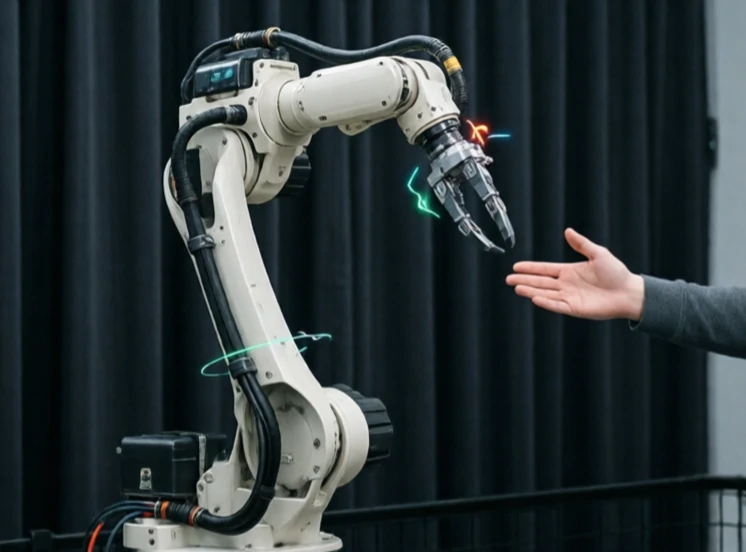
Imitation learning teaches robots by demonstration. A human performs a task, and the robot learns to copy it. Instead of programming every motion, the robot observes and mimics. It is how humans learn from each other, and it is becoming a powerful tool in robotics.
The simplest form is behavioral cloning. The robot records the human's actions and trains a policy to reproduce them. That works for simple tasks but fails when the robot encounters a situation not in the training data. More advanced methods use inverse reinforcement learning, where the robot infers the goal behind the demonstration and learns a reward function. Others use few-shot learning to generalize from a handful of examples.
Where imitation learning helps
- Assembly tasks with subtle force control.
- Kitchen tasks like slicing and pouring.
- Driving and navigation.
- surgical suturing and tool handling.
- Tasks that are hard to describe but easy to show.
Imitation learning is not a replacement for programming. It is a complement. A robot might learn the gross motion from a demonstration and the fine details from trial and error. The challenge is data. Collecting high-quality demonstrations is time-consuming. Teleoperation systems with haptic feedback make it easier. Simulation lets the robot practice thousands of variations. The dream is a robot that watches a human once and can repeat the task reliably. That dream is getting closer, but it is not here yet.
Comments
No comments yet. Be the first to share a thought.
Leave a comment