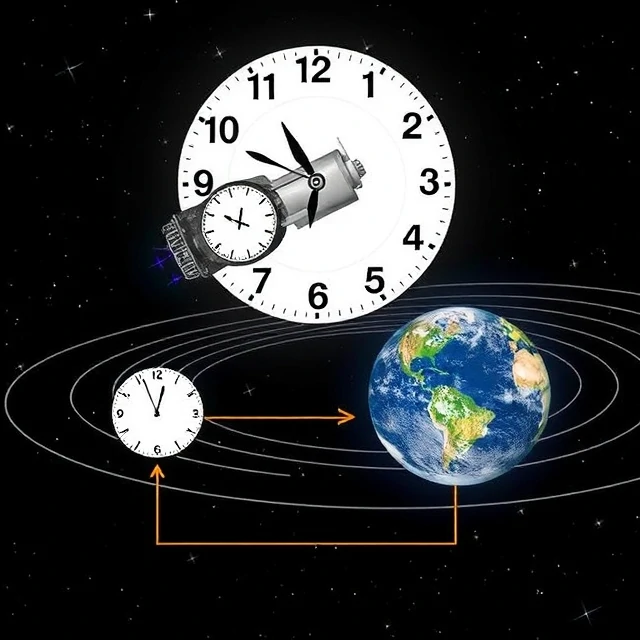
Einstein published special relativity in 1905, and it changed how we think about space and time. The theory rests on two postulates. The laws of physics are the same for all observers in uniform motion. The speed of light in a vacuum is the same for all observers, regardless of their motion. From those simple postulates come remarkable conclusions. Moving clocks run slower. Moving objects are shorter. Mass and energy are equivalent, E = mc². Simultaneity is relative. Two events that appear simultaneous to one observer may not appear simultaneous to another.
Special relativity applies to objects moving at constant speeds, especially speeds close to the speed of light. At everyday speeds, the effects are negligible. A jet flying at 500 mph experiences time dilation of about one part in a trillion. But at 99 percent of the speed of light, time slows dramatically and lengths contract noticeably. Special relativity has been confirmed by countless experiments. Particle accelerators rely on it. GPS satellites must correct for it. The theory is not intuitive, but it is correct. It is one of the two pillars of modern physics, along with quantum mechanics.
Special relativity facts
- Published. 1905.
- Postulates. Physics is the same for all inertial observers. Speed of light is constant.
- Consequences. Time dilation, length contraction, E = mc².
- Applies to. Constant speeds, especially near light speed.
- Confirmed by. Particle accelerators, GPS, experiments.
Special relativity is not the same as general relativity. Special relativity deals with constant speeds. General relativity deals with acceleration and gravity.
Comments
No comments yet. Be the first to share a thought.
Leave a comment