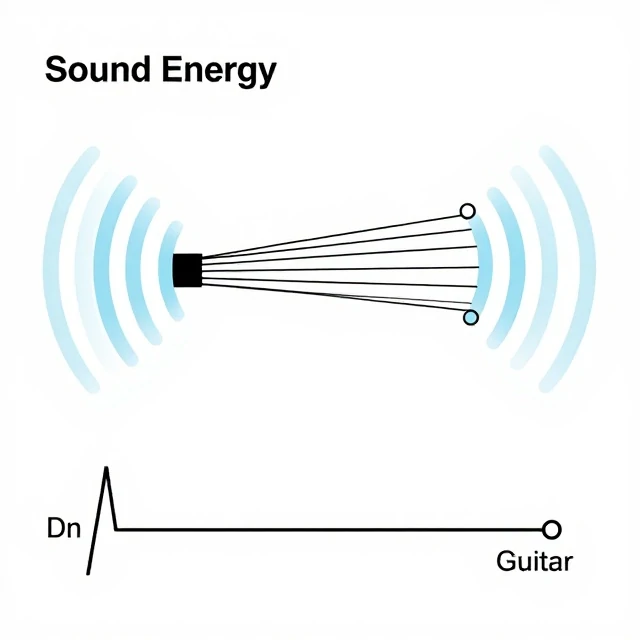
Sound energy is produced by vibrating objects and travels through a medium as waves. Pluck a guitar string and it vibrates. The vibrations push air molecules. The molecules bump into their neighbors. A pressure wave travels outward. Your ear detects the wave. You hear a note.
Sound needs a medium. It cannot travel through a vacuum. That is why space is silent. The speed of sound depends on the medium. In air, it is about 343 meters per second at room temperature. In water, it is about 1,480 meters per second. In steel, it is about 5,960 meters per second. The denser and stiffer the medium, the faster sound travels.
Properties of sound
- Frequency determines pitch.
- Amplitude determines loudness.
- Timbre determines quality.
- Speed depends on the medium.
- Sound reflects, refracts, and diffracts.
Sound energy is used in sonar, ultrasound, and music. Bats navigate with echolocation. Ships map the ocean floor with sonar. Doctors image fetuses with ultrasound. Musicians shape sound energy into art. The energy is small. A whisper carries picowatts. A rock concert carries thousands of watts. But the energy is enough to move your eardrum and trigger nerve signals. Sound is a mechanical wave. It is not electromagnetic. It cannot travel through space. It is the energy of vibration, passed from molecule to molecule. It is one of the oldest senses. It is how we communicate, navigate, and enjoy music.
Comments
No comments yet. Be the first to share a thought.
Leave a comment