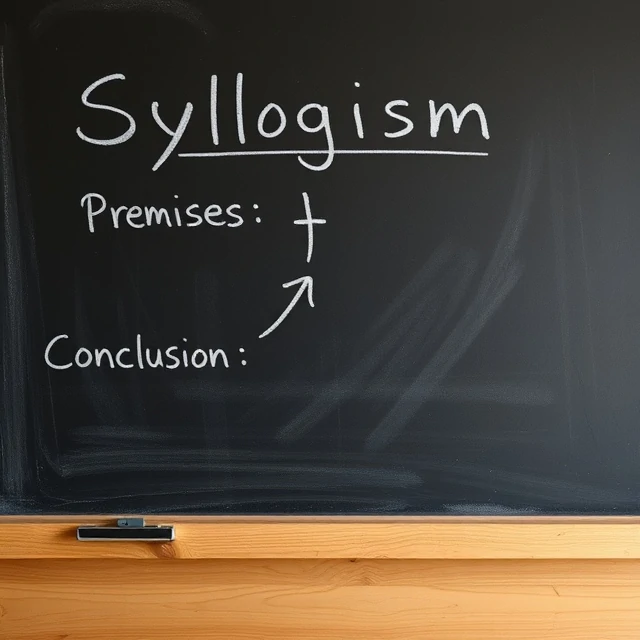
A syllogism is a form of deductive reasoning with two premises and a conclusion. Aristotle developed the syllogism as the basic unit of logic. The most famous example: All men are mortal. Socrates is a man. Therefore, Socrates is mortal. The first premise is the major premise, the second is the minor premise, and the third is the conclusion. If the premises are true and the form is valid, the conclusion must be true. The syllogism is a tool for testing the validity of arguments. By identifying the form, you can see whether the conclusion follows.
Aristotle identified several valid syllogistic forms, called figures and moods. The most common is the first figure, where the middle term connects the major and minor premises. Medieval logicians gave the forms mnemonic names, like Barbara and Celarent, to help students remember them. The syllogism was central to logic for over two thousand years. It was only in the 19th century that Frege and others developed more powerful logical systems. But the syllogism remains a useful teaching tool and a clear example of deductive reasoning. It shows how conclusions can be derived from premises with certainty, provided the form is valid and the premises are true.
Parts of a syllogism
- Major premise. The broader statement.
- Minor premise. The more specific statement.
- Conclusion. The statement that follows.
- Middle term. The term that connects the premises.
A syllogism is not the same as an argument in general. It is a specific form of deductive argument with two premises and a conclusion.
Comments (2)
Leave a comment