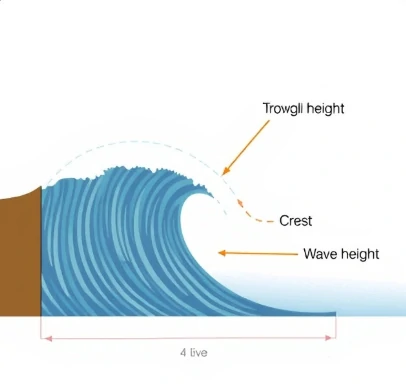
The vertical distance from the trough of a wave to its crest is the wave height. For a given sea state, individual waves vary; the significant wave height—roughly the average of the highest one-third of waves—is the standard statistic used in forecasts and design.
Wave height increases with wind speed, duration, and fetch, up to a physical limit set by breaking. In shallow water, height can increase further through shoaling before the wave breaks. Rogue waves represent extreme outliers far above the significant height of the surrounding sea.
Mariners, offshore engineers, and coastal managers rely on accurate wave-height information. Satellites measure height from the shape of radar returns; buoys measure it directly with accelerometers or pressure sensors. Numerical wave models predict height globally and are continually validated against these observations. Even moderate increases in typical wave height can accelerate coastal erosion over time.
- Vertical distance from trough to crest
- Significant wave height is the key statistic
- Depends on wind, fetch, and water depth
- Measured by buoys and satellites
Comments
No comments yet. Be the first to share a thought.
Leave a comment