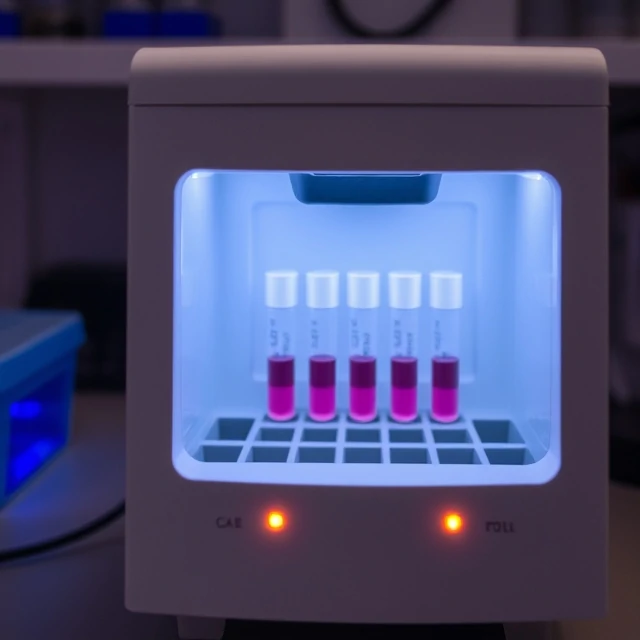
A single drop of blood or a faint crime-scene stain once held too little DNA for analysis. Polymerase chain reaction, or PCR, changed that by making millions of copies of a chosen DNA segment in a few hours. The method cycles through heating to separate strands, cooling to let short primers bind, and warming again so a heat-stable polymerase builds new strands.
Each cycle doubles the target, producing exponential growth. Researchers choose primers that flank the region of interest, ensuring only that stretch is amplified. Modern machines automate the temperature shifts and can finish a run in under an hour. The resulting DNA is pure enough for sequencing, cloning, or diagnostic tests.
PCR underpins forensic identification, infectious-disease detection, and countless research protocols. Variants such as quantitative PCR measure how much template was present at the start. Contamination remains a constant concern because even a few stray molecules can be amplified. Careful technique and negative controls keep results reliable.
- Amplifies specific DNA segments exponentially
- Uses repeated cycles of heating and cooling
- Requires primers and heat-stable polymerase
- Essential for diagnostics and molecular research
Comments
No comments yet. Be the first to share a thought.
Leave a comment