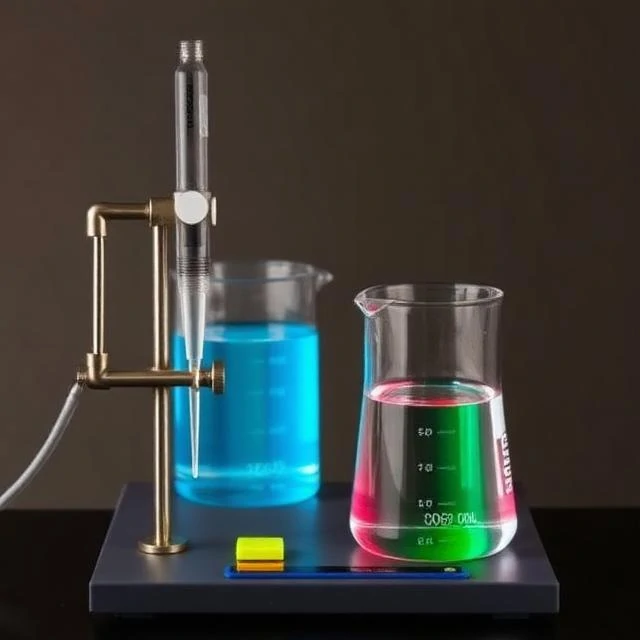
Mix hydrochloric acid with sodium hydroxide, and you get salt and water. The reaction is neutralization, the reaction between an acid and a base. The acid donates a proton, the base accepts it, and the products are a salt and water. The pH moves toward 7. The reaction releases heat, making it exothermic. It is one of the most fundamental reactions in chemistry.
The general equation is acid + base -> salt + water. The salt depends on the acid and base used. Hydrochloric acid and sodium hydroxide give sodium chloride. Sulfuric acid and potassium hydroxide give potassium sulfate. The reaction is stoichiometric: one mole of acid neutralizes one mole of base if the acid has one proton and the base has one hydroxide. For diprotic acids, two moles of base are needed.
Neutralization is used in many contexts. In the laboratory, it is used in titration to determine the concentration of an acid or base. In medicine, antacids neutralize stomach acid to relieve heartburn. In agriculture, lime is added to acidic soil to raise the pH. In environmental science, it is used to treat acid mine drainage and acid rain. In industry, it is used to control pH in chemical processes.
The reaction is not always complete. Weak acids and weak bases do not fully dissociate, so the pH at the equivalence point may not be 7. The choice of indicator matters. Phenolphthalein changes color around pH 8.2 to 10. Methyl orange changes around pH 3.1 to 4.4. The indicator must be chosen to match the equivalence point.
Comments
No comments yet. Be the first to share a thought.
Leave a comment