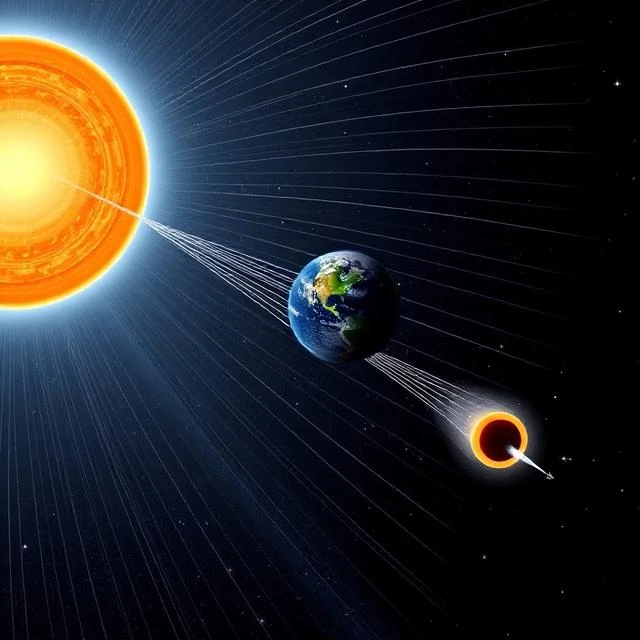
Earth's magnetic field extends into space, forming a bubble called the magnetosphere. It deflects the solar wind, the stream of charged particles flowing from the Sun. Without it, those particles would strip away our atmosphere and bathe the surface in radiation. The magnetosphere is why Earth is habitable.
The field is generated by the motion of molten iron in Earth's outer core, a process called the geodynamo. It resembles a dipole, like a bar magnet, with field lines emerging near the south pole and entering near the north. The magnetic poles are not the same as the geographic poles, and they wander. The north magnetic pole has been moving toward Siberia at about 50 kilometers per year.
The magnetosphere is not a perfect shield. Some particles leak in, especially near the poles, where field lines converge. Those particles collide with the atmosphere and create auroras. During solar storms, the magnetosphere compresses on the sunward side and stretches into a long tail on the night side. Satellites in orbit can be damaged, and power grids on the ground can be disrupted.
Other planets have magnetospheres too. Jupiter's is the largest structure in the solar system, extending millions of kilometers. Mars once had one, but it shut down billions of years ago, which may be why Mars lost its atmosphere.
Comments
No comments yet. Be the first to share a thought.
Leave a comment